Showing posts with label Andrew Sullivan. Show all posts

Sunday, June 22, 2014

David Brooks and Pottery Barn Imperialism

One of the reasons I continue to read David Brooks is that he is often unintentionally revealing. Since he is, I think, quite sincere, he does not indulge in clever subterfuge in making his arguments. Thus he sometimes lays bare what otherwise remains hidden behind what Andrew Sullivan last week (ironically) called "noble lies."

In his June 13 column, Brooks tries to lay the blame for Iraq's current travails at the foot of Barack Obama. Before American troops left in 2011, he writes:
American diplomats rode herd on Prime Minister Nuri Kamal al-Maliki to restrain his sectarian impulses. American generals would threaten to physically block Iraq troop movements if Maliki ordered any action that seemed likely to polarize the nation.
After U.S. troops left, he writes:
Almost immediately things began to deteriorate. There were no advisers left to restrain Maliki’s sectarian tendencies. The American efforts to professionalize the Iraqi Army came undone.
Brooks never acknowledges the obvious (though unstated) assumption behind all of this: that Iraq could not be expected to function without the United States. It seems that Nuri al-Maliki (hand-picked by George W. Bush in 2007, by the way) bears no responsibility for indulging his "sectarian impulses" (and note that Maliki is ruled by "impulse," not thought or calculation), and the Iraqi army bears no responsibility for not being professional. It is all due to the absence of Americans, who of course, know best.

Brooks says, quite without irony, that "Iraq is in danger of becoming a non-nation." It never occurs to him that a state that--according to him--cannot function without American diplomats riding herd and American generals threatening its leader might already be a "non-nation."

Without knowing it, Brooks embraces an imperial role for the United States. It was America's job to control the Iraqi government, make it do the right thing. The United States should have stayed in Iraq for as long as it took. Leaving Iraq was "American underreach."

Brooks also embraces the reflexive American-centric mindset far too common on both the left and the right in the United States: the idea that whatever happens abroad happens because of something the United States either did or did not do. An incorrect American policy of withdrawal led to this state of affairs. It necessarily follows that whatever is going on in Iraq now can be fixed by the correct American policy.

Neither of those things is true. It is an illusion that Americans cherish because they think it gives them control over a chaotic world.

The American invasion of Iraq in 2003 broke Iraq. Iraqis thus far have not been able to put it back together. Maybe they never will. The lesson to be learned from that, however, is not what Brooks would have us believe: "The dangers of American underreach have been lavishly and horrifically displayed."

In the lead up to the Iraq War in 2003, Colin Powell allegedly talked about the so-called "Pottery Barn rule: You break it, you own it." The true lesson of Iraq is this: that American military intervention can easily break a country. It does not follow that American military intervention can just as easily make a country. Having disastrously bungled in breaking Iraq, Brooks would now have the United States once again bungle in trying to make it.

What the United States must "own" is not the state of Iraq, but the responsibility for breaking that state. Those are not the same thing. Responsibility begins with not making the situation worse by repeating the original mistake.

David Brooks, it seems, never learned that lesson. One hopes Barack Obama has.

Monday, November 4, 2013

Experience Becoming

One of the great things about reading a variety of kinds of writing from a variety of sources is the occasional serendipitous connection it helps you make.

I read yesterday's Education Life section of the New York Times, growing increasingly agitated at the mindless cheerleading in its section titled "The Disrupters." Article after article treats the reader to largely uncritical accounts of various "edupreneurs" (no, that word is not my snarky coinage, but what some of these people evidently call themselves). 

We are promised (or is it threatened?) that "the disrupters" are on the verge of "disrupting" higher education by bringing the always perfect approaches that universally serve the private sector so well to that hopelessly outdated institution, the American college/university. (That sentence is snarky.)

There so many things wrong with every one of those articles that I could not focus on any one of them. The avalanche of mindless corporatespeak passing itself off as wisdom and insight and innovation was just too overwhelming.

So to break the spell of banality, I went online to Andrew Sullivan's The Dish and saw this link to a letter by Kurt Vonnegut (which everyone should take a minute or two to read).

At first, I simply enjoyed the letter. But within a few minutes, I realized that it had brought into perfect focus one of the things that had bothered me most about the New York Times articles. Vonnegut's advice to a group of high school students was simple:
Practice any art, music, singing, dancing, acting, drawing, painting, sculpting, poetry, fiction, essays, reportage, no matter how well or badly, not to get money and fame, but to experience becoming, to find out what's inside you, to make your soul grow.
Becoming.

That's what was missing in all of these breathless edupreneurial proposals to disrupt higher education, but its absence was most obvious in one in particular: awarding degrees based simply on demonstrating competence in various areas.

Something calling itself College for America offers an associates degree for $1250 per six month term. Students can breeze through as quickly as they like. The article highlights one young man who completed all "120 competency goals he was given" in only "three months and five days"--in other words, he got a two-year degree in one semester, for very little cost.

Pretty impressive, huh? Well, not if the goal was education.

This man got a degree. He did not get an education. Education is about becoming. It is not simply a checklist of (often employer-determined) competencies. This man had no time at all for reflection, no time for actual learning, no time for any of the discrete assignments he tackled to percolate in his unconscious, no time for the unplanned, unexpected connection to form and develop and blossom.

None of these supposedly "disrupting" ideas care one bit about those things. All we hear is that they will cut costs or speed up the process of getting a degree. Whether these ideas actually do anything to help students become something (other than a person with a "marketable diploma") seems to be of little or no concern to these Disruptive Masters of the Educational Universe.

A college is not simply a job-training institute. Its purpose is not to turn out interchangeable cogs who have been trained in specific marketable skills that our corporate masters dictate they must have.

At its best, it gives young women and men the chance to to find out what's inside them, to become who they want to be. You don't do that in three months of producing "deliverables." You don't do that sitting at home in front of your computer looking at online videos. You don't do that with the aid of "academic success coaches."

Those things might get you a "marketable diploma" but they will never get you an education. As long as it makes them a profit, the edupreneurs could not care less.

The rest of society should.

Wednesday, August 14, 2013

The Egyptian Tiananmen

In light of today's horrors in Egypt, Andrew Sullivan, Marc Lynch, and others are now calling for the cutting off of aid to Egypt. While that is the right thing to do now, it is a classic case of too little, too late.

The time to end the aid was after the coup, as the law required. By twisting itself in knots to pretend the coup was not a coup, the Obama administration signaled to the Egyptian generals that it valued its relationship with them more than the democratic process. The military no doubt took that as effectively a green light for today's events.

The administration allowed a simplistic idea of realpolitick to convince it that the worldy-wise way to approach the coup that removed Morsi from power was to finesse the situation. It would maintain its influence with the generals by showing that it had faith in their intentions to restore democracy. Lynch writes:
It seemed prudent to many in Washington to wait and see how things would play out, especially given the intense arguments of those defending what they considered popular revolution. It didn't help that neither the United States nor other outside actors knew quite what they wanted. Few particularly wanted to go to the mat for the Muslim Brotherhood or a Morsy restoration, and Washington quickly understood that this was not in the cards. But they also didn't want a return to military rule.
What Obama should have done instead was use the law requiring an aid cut-off as a way of pressuring the Egyptian military to restore quickly a legitimate government with a popular mandate. Obama would have had the excuse of saying that the coup left him with no options. Secretary of State Kerry then could have quietly made assurances that the aid would be immediately resumed once an elected government was in place.

Such a course would have given the administration actual leverage. Instead, its refusal to call a coup a coup sent precisely the wrong message.

What should have been clear before is now undeniable: when the military acted to remove Morsi from power, it was not acting on the popular will. It was rather exploiting the anti-Morsi protests to do what it wanted to do all along: decapitate the Muslim Brotherhood. By not objecting, the administration implied that it shared that objective. Was it really so odd that the Egyptian generals believed that if they could remove an elected president without consequences, they could also violently disperse protestors?

In academic discussions of American foreign policy, there is a common division between those who argue that U.S. diplomacy should be guided by ideals and those who say it should only serve material interests. In this case, that is a false choice. A stable Egypt, with real respect for democratic process, in which the Muslim Brotherhood has a stake in electoral politics, is in America's interest, but today that result seems sadly unlikely. By taking an allegedly "hard-headed" approach focused purely on interests, the Obama administration has served neither American ideals nor its interests.

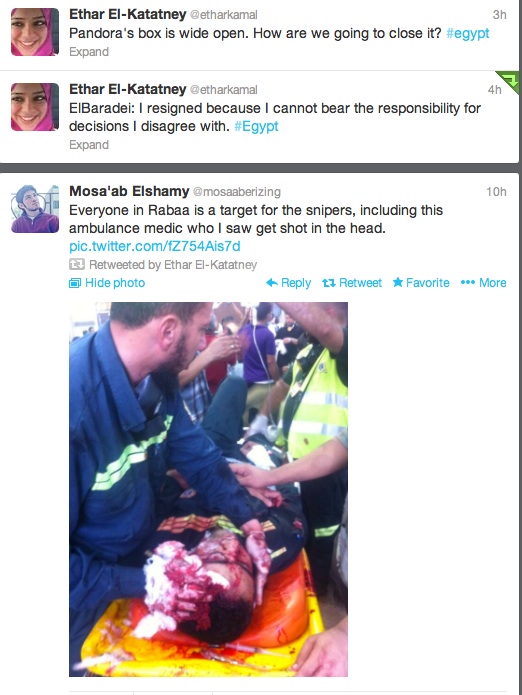
As Ethar El Katataney says in the tweet pictured above, "Pandora's Box is wide open. How are we going to close it?"

Friday, April 12, 2013

Rand Paul's "Outreach"

Commenting on Rand Paul's address at Howard University, Andrew Sullivan wrote yesterday:

"I have to say the sheer lack of any grace among some liberal commenters on what was an obvious outreach to African-Americans depresses me." Sullivan thinks critics have been "too harsh" and that Paul deserves some credit for his criticism of the drug war.

Sorry, but the fact that Paul had one idea that might actually benefit some part of the black community does not mean he gets a pass on the rest of that address.

Like his father, Rand Paul often does get a pass because of the evident sincerity of his beliefs. Sincerity is certainly refreshing among politicians and to be lauded when it appears. But I find it hard to believe Paul was being sincere at Howard University.


I wrote nearly three years ago in the aftermath of his infamous interview with Rachel Maddow, "I believe Paul is sincere when he says he has no racial animus." I still believe that (that some people seem to think this in itself is notable and commendable is a sad commentary in and of itself).

But when confronted with that interview by a questioner at Howard, Paul disputed that he had ever "wavered in my support for civil rights or the Civil Rights Act." That is simply not true. He is on record opposing the part of the act that applies to privately owned businesses.

He believes that restaurant owners ought not to discriminate against black customers because it is bad business, but he does not believe government should make that illegal. He opposes that part of the Civil Rights Act (and a not insignificant part it is). But he did not have the integrity to say that at Howard. He lied instead.

Paul was also asked by a questioner: "Are we discussing the Republican Party of the 19th century or are we discussing the post-1968 Republican Party?" His response was either dishonest or stunningly ignorant: "The argument I'm trying to make is we haven't changed," he said.

Paul completely ignored the history of the "southern strategy," with which the questioner was clearly familiar. Even when asked about it, Paul simply denied it. Instead he said: "the Republican Party has always [emphasis added] been the party of civil rights and voting rights."

There can be no true Republican "outreach" or "re-branding" on civil rights unless the party ends its denial and confronts and forthrightly repudiates its history since the Civil Rights Act. The undeniable truth is that the GOP made a conscious, deliberate decision to exploit the white backlash against that law, and has been reaping political benefits among some white voters ever since.

Also on the topic of Republican re-branding, one aspect of Paul's address has gotten relatively little attention: the way he revealed that he basically shares Mitt Romney's 47% mindset and Paul Ryan's "makers and takers" rhetoric.

After extolling the largely positive civil rights record of the Republicans through the 1950s, Paul did attempt to explain why the GOP lost African-Americans. His explanation is the same as Romney's for why he lost the last election: the Democrats bought black votes:
"I think what happened during the Great Depression was that African Americans understood that Republicans championed citizenship and voting rights but they became impatient for economic emancipation.... The Democrats promised equalizing outcomes through unlimited federal assistance while Republicans offered something that seemed less tangible-the promise of equalizing opportunity through free markets."
"Equalizing outcomes through unlimited federal assistance." The Democrats bought your votes, he effectively said, by offering you free stuff. And, unfortunately, African-Americans somehow have failed to see the "less tangible" benefits of Republican policies. He seems blissfully unaware of how insulting that argument is.

He also plays a cynical game. He tries to turn his brand of libertarianism into the instrument of black liberation, by equating his aversion to federal power in general with the African-American opposition to the abuse of power by the states of the Jim Crow South.

"The history of African-American repression in this country rose from government-sanctioned racism." That much is true.

"Jim Crow laws were a product of bigoted state and local governments." Also true.

"Big and oppressive government has long been the enemy of freedom, something black Americans know all too well."

Not true.

It was not "big" government that brought about Jim Crow. It was oppressive small governments. It was an empowered, big, federal government that proved to be the only institution in America able to end Jim Crow. African Americans know that, even if Rand Paul pretends to be naively unaware of it. His blinkered view of freedom is one that, had it ruled the day in 1964, would have left intact the daily insults to the dignity of every African American, as long as the perpetrators were private individuals and businesses. The audience at Howard knew that too.

Paul also showed an appalling ignorance of the Constitution: "The bill of rights and the civil war amendments," he said, "protect us against the possibility of an oppressive federal or state government." It makes no sense to conflate the Bill of Rights and the Reconstruction Amendments. The first ten amendments all limit the federal government, but the 13th, 14th, and 15th all empower the federal government. And it was that empowerment that made possible the final abolition of slavery, the temporary civil rights advances of the Reconstruction era, and eventually, the Civil Rights and Voting Rights Acts.

People who do not wear the kind of ideological blinders permanently attached to Paul know that federal power is neither inherently good nor inherently bad. It depends on circumstances, on how it is employed. But that seems too confusing for the simplistic libertarian mind to wrap itself around. It is so much easier to just flatly deny any historical reality that contradicts your infallible ideology. And then condescendingly tell other people, who know all too well that historical reality, that they have simply failed to appreciate your truth because your ideas "seemed less tangible."

Rand Paul had barely begun his speech when he effectively congratulated himself for giving it: "Some have said that I’m either brave or crazy to be here today." Andrew Sullivan may be more inclined to the former, but if Rand Paul honestly thinks the message he gave at Howard was true "outreach" that will win over many African American voters, I'm inclined toward the latter.

Friday, January 13, 2012

Romney, Bain, and the End of the Reagan Coalition

Listening the last couple of days to the Republican crack-up over Mitt Romney and his time at Bain Capital has been fascinating. Conservatives have pounced on Newt Gingrich and Rick Perry for their harsh criticisms of Romney. Perry, for example, has said: "We need more venture capitalism, and less vulture capitalism."

This is an attack from the "left," observers left and right have said. It is not conservative. Rush Limbaugh sputtered in exasperation: "My gosh, that's what the people who indict capitalism say ... this sounds like left-wing social engineering." Gingrich, Rush said, "sounds like Elizabeth Warren."

I couldn't disagree more. This isn't an attack from the left, it is an attack from within the unstable marriage that has been the Republican Party for at least the last thirty years. What's happening, I think, may be nothing less than the disintegration of the Reagan coalition.

The idea that the critique of Romney and Bain is "left-wing" is only true if you conceive of modern American conservatism in extremely narrow terms. By any reasonable definition of the word "conservative," the critique (especially as made by Newt Gingrich) is in fact deeply conservative.

What we are seeing here is the tension, if not outright contradiction, between two strands of modern American conservatism. On the one hand, conservatives value tradition. They talk about small-town values: family, work, religion. But the other strand is unrestrained free-market capitalism, the single most progressive force in history. The essence of capitalism is incessant change. Everywhere it has enjoyed free rein, it has undermined traditions and traditional values.

Ever since Herbert Hoover, the Republican Party has tried to maintain a coalition that includes both strands. Hoover was the epitome of both small town values and capitalist business success: born in the heartland (Iowa), he was orphaned at age 9, overcame being shuffled around for several years, attended Stanford, became a mining engineer, sought his fortune abroad, and became a self-made millionaire. As president during the depression, he warned against the moral degeneracy of dependence on the state.

But the Republican political leader who best combined these strands was, of course, Ronald Reagan. Like Hoover, he came from humble origins. But unlike Hoover, he became "the Great Communicator," a politician who never lost the common touch. The key to his political success was winning over the so-called Reagan Democrats: white, middle-class voters who had become disaffected with 1960s liberalism, and whose economic interests had suffered in the stagflation of the 1970s.

Modern American conservatives, however, have sometimes had trouble maintaining the coalition Reagan forged, and in Romney's Bain experience, we have a stark example of why it can be so hard.

When faced with the recent criticisms, Romney has relied on the power of the free market strand of conservatism. He claims that all of the attacks on him are meant to put "free enterprise on trial." In that, he has the support of Ron Paul, conservatism's purist defender of laissez-faire capitalism: “Bankruptcy and restructuring are very important principles in free markets.”

Free markets always create the correct, and moral, result according to this doctrinaire view. If people get fired in the pursuit of greater profits, so be it. The greater economic good counter-balances whatever harm may have been done by the invisible hand.

But we all know that unemployment is socially corrosive. When people lose their jobs, families suffer. It puts tremendous strain on them, sometimes they break up. When a company goes bankrupt, it can destroy an entire community.

That is the thrust of the devastatingly effective video put out by the pro-Gingrich Super Pac.


What  makes it so powerful is the testimony of real people put out of work by Bain. These are the Reagan Democrats. They come off, as Andrew Sullivan notes, not as "envious," as Romney condescendingly puts it. "They come off as bewildered, betrayed and sure that Romney's goal in all this was merely, solely to make money for himself - the kind of money that most Americans cannot even compute."

Newt's real apostasy here is that he is pointing out the contradiction that has always been there: the market is not inherently moral. The workings of free enterprise can be entirely legal and also immoral.

And, believe it or not, Gingrich is making the moral argument.  Here's how he put it on MSNBC Wednesday:
A company Bain had invested $30 million in, they took $180 million out -- that's 6 to 1-- and the company went bankrupt. And you have to ask yourself, if you're going to get a 6 to 1 return when the company's going bankrupt, gee, what if you'd only taken  3 to 1? ... Just because you have the right to do something, doesn't mean it's the right thing to do.
This is the traditional values argument: doing the right thing. In the video, we see families harmed, we see good people who want to work unable to support those families. We see them sincerely question whether what Bain did was morally right.

This is a conservative case, one that harkens back to an older, pre-capitalist, communitarian ethos, one that values the stability of the community, one that seeks a balance between the interests of the individual and those of the whole.

For advancing this line of attack, Republicans and other conservatives are roundly condemning Gingrich. The president of the right-wing Club For Growth has accused Newt of engaging in “economically ignorant class warfare” and making an "attack on a basic tenet of economic freedom."

Newt has rightly countered: "Criticizing one businessman for one set of practices is not an assault on capitalism." Of course that's true. But there's a good reason today's conservatives cannot agree to that. They're all in. They have fully committed to the free market strand of conservatism.

Note how John McCain put it to Fox News: "To go after [Romney], on really what is the essence of what we Republicans believe about economy, is a serious mistake.... There's an alternative to how Bain does business. It's called communism."

In other words, the distinction Newt makes -- between the ideal of capitalist competition and the predatory practices of Bain -- simply does not exist for today's Republican Party. It is either unrestrained free market, with all of its excesses and destruction (both "creative" and not), or it is communism. There is no middle ground.

Republicans and conservatives cannot acknowledge the conservative moral legitimacy of the Gingrich critique because they have been damning it for at least the last three years. To say that Gingrich has a point would invalidate their entire critique of Barack Obama: it would expose the "Obama is a socialist" line for the idiocy that it is.

It is Obama who has been making the conservative critique of capitalism. It is Obama who has been criticizing specific businessmen and specific business practices. It is Obama who has championed Wall Street reform and consumer protection -- not because he doesn't believe in capitalism (as Republican demagoguery would have it), but because, like Theodore and Franklin Roosevelt before him, he sees that capitalism is in crisis and needs to be saved from its greatest and most self-destructive excesses.

There is no room for such a view among the power elites of the Republican Party and conservative movement. They have forgotten that the moral component of conservatism was never merely lip-service opposition to abortion or gay marriage. At its best, it has been much more than that.

Reagan knew that. As Obama has adroitly noted, his so-called "Buffett Rule," far from being "class warfare," was Reagan's idea.  In 1985, Reagan said that tax loopholes "sometimes made it possible for millionaires to pay nothing, while a bus driver was paying ten percent of his salary, and that’s crazy.... Do you think the millionaire ought to pay more in taxes than the bus driver or less?"

That same year, Reagan said the following:
I told some people ... of a letter that I just received ... from a man out here in the country, an executive who's earning in six figures -- well above $100,000 a year. He wrote me in support of the tax plan because he said, “I am legally able to take advantage of the present tax code -- nothing dishonest, doing what the law prescribes -- and wind up ... paying a smaller tax than my secretary pays.” And he wrote me the letter to tell me he'd like to come to Washington and testify before Congress as to how that's possible for him to do and why it is wrong [emphasis added].
Legal, nothing dishonest -- but wrong. Reagan knew the difference, and knew how important that difference was politically. Today, in his political desperation, Newt Gingrich also knows it matters politically.

In his segment on Romney's Bain problem Wednesday night, Lawrence O'Donnell put it beautifully:
The freedom to choose our occupations, the freedom to choose what we will do for money, requires us to check, not just if it's legal, but if it is the right thing to do.... What we do for money, and what harm we do while doing it, goes a long way to define who we are.
O'Donnell is a liberal, but that is a fundamentally conservative statement: freedom is not license, freedoms come with responsibilities, and we are responsible not just to ourselves, but to others and to our communities.

This debate over Romney and Bain is not about Republicans sounding like Democrats, or about both parties trying to be economic populists: it is about the moral dimension of our politics. It's something that a significant number of Republican voters value, but that the radical individualists among the Tea Partiers and libertarians either reject or flatly deny, and the corporate elite don't even understand.

Gingrich is, of course, primarily motivated to make these attacks by personal animus to Romney due to the negative ads that killed Newt's chances in Iowa. But one of Newt's (few) political virtues is that he does sometimes see a bigger picture. In this case, he knows that the Republicans, if they nominate Mitt Romney, are handing this potent political issue to President Obama, and with it, possibly, an essential component of Republican political success over the last 30 years.

If Obama can take advantage of Romney's moral blindness and regain a significant number of Reagan Democrats, he will win re-election. If he can go further and recapture the mantle of the moral dimension of politics, he can realign American politics and fracture the Reagan coalition.

Tuesday, January 10, 2012

Andrew Sullivan Gets Eisenhower Wrong


Andrew Sullivan has an innovative video feature on his blog, The Dish, now at the Daily Beast. In "Ask Andrew Anything," Sullivan gives video replies to reader questions. These replies are an interesting way of expanding blog content, but today's installment gets some history quite wrong.

The question was "Why do you think Eisenhower was the greatest president of the 20th century?" I agree with the general thrust of the reply, which echoes the revisionist case that Ike was far more effective than people at the time realized.

However, comparing Ike to JFK, Sullivan says: "You can certainly say this thing: that Eisenhower would never, ever, ever have done the Bay of Pigs in a million years.... and I doubt would have gotten us entangled in Vietnam either."

Both of those speculative statements are contradicted by the historical record.

The Bay of Pigs invasion of Cuba, in which CIA-backed Cuban exiles tried to overthrow the Castro government, took place less than three months after Kennedy took office. The planning was not a Kennedy initiative, but had begun a year earlier during the Eisenhower administration, when the president approved a National Security Council paper calling for covert action to overthrow Castro. The specific Bay of Pigs plan was approved by Eisenhower after the election, in late November 1960. Kennedy inherited the operation from the Eisenhower administration. It is simply wrong to say "Eisenhower would never, ever, ever have done the Bay of Pigs in a million years." Ike approved it. It was Ike's plan.

Now, some might quibble that JFK didn't actually implement Eisenhower's plan because he did not supply American air cover. Without delving into the morass of that particular controversy, let me simply say that Sullivan's argument is based on the premise that Ike was prudent and cautious, a president who "presided," while Kennedy was rash and "radical." Ike's approval of a more provocative step than JFK took is hardly evidence of that.

On Vietnam, Sullivan might seem to be on stronger ground--his claim is less absolute ("I doubt") and since Ike was not president, we'll never know with absolute certainty.

But we do know what Ike advised LBJ to do in 1965. Johnson knew that the prestige Eisenhower enjoyed could be a politically effective tool in garnering public support for escalation. When Ike was briefed on Gen. Westmoreland's recommendation for escalation in June 1965, Eisenhower reportedly said "We have got to win."

More conclusively, thanks to LBJ's telephone conversation recordings, we have direct, irrefutable evidence of Eisenhower's thoughts. Johnson spoke to the former president on the morning of July 2, 1965. Ike said: "You've got to go along with your military advisers ... My advice is, do what you have to do." He advised LBJ to say to the Vietcong and North Vietnamese: "Hell, we're going to end this thing and win this thing.... We don't intend to fail." His final word to LBJ? "I would go ahead and ... do it as quickly as I could."

We don't have to guess what Ike thought about escalation in 1965. Sullivan's view initially seems plausible, given Eisenhower's own decision in 1954 not to bail out the French at Dienbienphu. Less than a year after ending the Korean War, Ike had no interest in getting into another land war in Asia.

But (and this is what Eisenhower admirers overlook) he did commit the United States to maintaining an independent South Vietnamese government. That commitment, the one LBJ always said his policy was meant to keep, was Eisenhower's commitment. When it came down to it, Eisenhower supported troop escalation in 1965 to keep the commitment he himself had made.

There was much that was prudent about Eisenhower's presidency. He did end the Korean War, he did avoid direct American involvement in the French war in Vietnam. But he also endorsed what in retrospect were clearly counterproductive and even reckless covert operations in Iran in 1953 and Guatemala in 1954, and those "successes" gave rise to the hubris of the Bay of Pigs. He made the ill-advised commitment to South Vietnam, leaving his successors to make good on it. In neither case do his actions fit Sullivan's admiring portrait.


Thursday, December 8, 2011

Rick Perry's Theocratic Vision

Rick Perry's new "I'm a Christian" ad is evidence that the people he's targeting do not understand something fundamental about the American system that they proclaim is so "exceptional." The mindset expressed in the ad is nothing short of theocratic.


Perry says: “there’s something wrong in this country when gays can serve openly in the military but our kids can’t openly celebrate Christmas or pray in school.” Discussing that passage, Andrew Sullivan writes:
we get a classic non-sequitur: the notion that allowing openly gay servicemembers to serve without fear of prosecution is somehow connected to the constitutional prohibition of prayer in schools. There is zero connection between the two issues - except both are objected to by Christianist fundamentalists.
I think there is a connection between the two, beyond what Sullivan says, and that the way Perry connects the two is instructive.

Perry is really saying that government, by allowing open service by gays in the military, is thereby endorsing who they are. Defending the ad today, Perry said: "President Obama has again mistaken America's tolerance for different lifestyles with an endorsement of those lifestyles."

In Perry's mind, treating people whose conduct you personally find to be contrary to your own morality as equals in the public sphere is an endorsement--it is saying that who they are and how they act is right and good. In his mind, there is no room for saying "that's none of my (or the government's) business."

In effect, he is saying that there is a moral standard (one that is set by his own view of Christianity) to qualify for equal citizenship. It is hard to imagine anything more contrary to a foundational principle of American government, expressed in the words engraved in the Supreme Court building: "equal justice under law."

Perry then makes a comparison between open service and not allowing schools to endorse Christianity via prayers and Christmas celebrations. That's why they are connected in his mind, and in the minds of those to whom he is appealing. Government, he says, is endorsing homosexuality (which it should not do), and is not endorsing Christianity, which it should do.

The common element is the idea that government has a role to play in endorsing some moral principles and condemning others. Government should not, Perry is suggesting, treat all people equally: it should endorse some and condemn others. That is a theocratic mindset.

Perry looks at the inclusiveness that a pluralistic society demands (everyone is treated equally under the law) and the refusal to endorse one religious vision (which a pluralistic society also demands) and wants us to see a contradiction. In fact, the two things are perfectly consistent with each other--if one believes (as the Founders did) that there should be no religious test for citizenship.

Perry's problem is that he either does not understand that, or does not believe in it. He thinks government should discriminate against those whose private behavior he abhors and should publicly advance his particular religious beliefs even though they are not universally held. He is saying that failing to give Christians a superior position in American society is effectively discrimination against Christians.

In this worldview, there is no room for equal protection under the law. This is truly 1984 territory: failing to discriminate against minorities is discriminating against the majority.

It is disturbing enough that an allegedly serious candidate for the presidency in 2012 could espouse such views. It is even more disturbing that he seems to think it will appeal large number of Republican primary voters. It would be most disturbing were it to turn out that he's right.

Friday, September 9, 2011

A Third Party Bid for Palin?

Observing what he calls "Palin's Populist Twist," Andrew Sullivan writes:
I wonder if she's contemplating a populist third party campaign. Or if this anti-establishment message is what she will bring to the GOP contest. Or whether she is just trying to recast her celebrity image a little. Well, we'll soon find out.
I had the same third party thought when she gave a speech that seemed meant to hit Obama, Romney, and Perry all at once. But if she does intend to do a third party challenge, we may well not soon find out.

I can see her saying she’s not in the GOP race, and then dangling the tease about a possible third party bid if the nomination contest results in a candidate who doesn’t offer a real choice. Since she has made it clear that she does not intend to not run according to traditional rules, she can take a long time to decide on that—maybe until there is an actual Republican nominee.

She may be so narcissistically deranged that she thinks her base would be enough to get her an electoral college win. Or maybe she is as shrewd as Sullivan says and realizes that, with her high negatives, the only way she could win is in a three-way race.

There is precedent for a candidate reviled by a large section of the public being elected president: Abraham Lincoln. He was despised in the South, but was elected president with less than 40% of the popular vote because he won heavily populated Northern states in an election with three or four major candidates (based on your definition of "major").

In 1912, in the midst of an era of Republican domination of the presidency, Democrat Woodrow Wilson won with 41.8%, because the Republicans divided between incumbent William Howard Taft and former president Theodore Roosevelt.

These two examples, however, show the problem Palin would face if she did launch an independent bid for the presidency.

Lincoln's advantage was that his vote was concentrated exclusively in the populous Northern states with lots of electoral votes. His inability to garner any votes in the South did not hurt him. Wilson's advantage was that he was running against two Republicans (though TR rebranded himself as the "Progressive" Party candidate that year). Wilson could rely on a loyal and united Democratic base.

Palin would have neither of these advantages. Her supporters are geographically scattered, and even if she portrayed herself as an independent or "Tea Party" candidate, she would be remembered by voters as the Republican vice-presidential candidate from 2008. Her vote would be drawn from those Republican and "change" votes that would otherwise go to the Republican nominee.

In other words, she'd be more likely to be the 2012 equivalent of Ross Perot, who got nearly 19% in 1992 and  8.4% in 1996.

But if Palin really burns to be president (as opposed to merely using the possibility of a run to rake in cash), a third-party bid is probably her only chance.  In a poll that asked not favorable/unfavorable but gauged enthusiasm for and against candidates, an abysmal 58% said they'd never vote for Palin.

However, she also scored 15% on the question of who would vote for "enthusiastically." That doesn't sound great either, until you notice that the only other Republican who scored as well was Mitt Romney, also with 15%. Another 24% said they'd "consider" voting for Palin.

With those numbers, there is simply no way Palin could win a two-way race. However, in a hypothetical Obama-Romney race, Palin may well believe she could enter as a self-proclaimed Tea Party candidate, mobilize the Tea Party base, get votes from those not enthused about Romney, and squeak out a narrow victory.

I think that scenario is extremely unlikely, even delusional. But I also think neither of those things would matter much to Palin. And it is the only way she could win a presidential election.


Monday, August 22, 2011

"Politics End at the Water's Edge"--Yeah, Right


The old maxim "politics ends at the water's edge" has always been an exaggeration, if not a flat-out falsehood. The idea is that while Americans may quarrel among themselves about domestic politics, when it comes to foreign affairs, there is no partisanship. Americans show a united face to the rest of the world.

As a historian of American diplomacy, I can tell you that, as a rule, nothing could be further from the truth. Yes, there is a tendency to "rally around the president" in moments of crisis, but that usually ends as soon as the crisis does. And yes, there are some moments when it is true, as when Democratic president Harry Truman convinced the Republican Congress in 1947 to approve the Truman Doctrine aid to Greece and Turkey, as well as the economic development program known as the "Marshall Plan."

More often than not, however, foreign policy has proven divisive in American history. Even the most prominent example of bipartisan cooperation noted above, the Marshall Plan, proves that point. It was packaged by the Truman administration as Secretary of State George Marshall's plan precisely because, as a former general, Marshall was seen as a nonpartisan figure. They were afraid the "Truman Plan" would get voted down.

This all came to mind while watching the events in Tripoli last night. Senators John McCain and Lindsey Graham released a statement, part of which reads as follows:
This achievement was made possible first and foremost by the struggle and sacrifice of countless Libyans, whose courage and perseverance we applaud. We also commend our British, French, and other allies, as well as our Arab partners, especially Qatar and the UAE, for their leadership in this conflict. Americans can be proud of the role our country has played in helping to defeat Qaddafi, but we regret that this success was so long in coming due to the failure of the United States to employ the full weight of our airpower.
As Andrew Sullivan's Dish points out, they make a point of "Praising Everyone But The Commander In Chief." President Obama's name does not appear at all in the statement. The only reference to him is the critical dig at "the failure of the United States to employ the full weight of our airpower."

The slight is reminiscent at how many conservatives pointedly refused to credit the president for getting Osama bin Laden. Conservative billionaire David Koch, for example, said "all that Obama did was say 'yea' or 'nay,' we’re going to take him out or not. I don’t think he contributed much at all." Sarah Palin credited "all the brave men and women in our military and our intelligence services" without mentioning the president, which the Guardian called "both churlish and in character."

Current Republican presidential candidates Michele Bachmann, Rick Santorum, and Herman Cain all issued statements that pointedly ignored Obama. (To their credit, Mitt Romney, Jon Huntsman, and Newt Gingrich, as well as Speaker of the House John Boehner, did congratulate the president.)

It is perfectly reasonable to question the president's policy. I had my own doubts about Obama's intervention in Libya, but it was indeed "churlish," on the day the rebellion reached Tripoli, for McCain and Graham to reiterate their policy criticism. At this point, it seems that Obama's policy, which has often been ridiculed because aides used the phrase "leading from behind" to describe it, has helped produce the successful toppling of one of the world's worst (and most bizarre) dictators. At the cost of not a single American life.

You might think that, at such a moment, the president's critics could actually let politics end at the water's edge. But you'd be wrong.

Thursday, August 4, 2011

"Stand Firm. The Tug Has to Come": Obama, Lincoln, and the Debt Ceiling

The Great Debt Ceiling Debacle is ended at last. So the angst-ridden grousing has commenced in earnest.

On what passes for the "left" in America, the main topic has been what many see as President Obama's capitulation to Republican intransigence. Many other observers, with far greater mastery of the policy details and political angles, will be hashing that matter out for weeks and months to come.

What I have found fascinating is how much Abraham Lincoln has been drawn into this. I've done it myself, in my last post.

More importantly, Obama himself did, in this video from March which the White House released in the midst of the debt ceiling negotiations.


In the most widely quoted section, Obama notes that Lincoln even compromised on the subject of slavery, since the Emancipation Proclamation exempted slaves still in the Union: "This notion that somehow if you're responsible and you compromise, that somehow you're giving up your convictions -- that's absolutely not true," Obama told the students.

Salon's Joan Walsh supported Obama on this point, despite her dissatisfaction with the then-emerging debt deal: "So if you're Obama looking to Lincoln as the man who tried to steer the United States through its worst domestic political crisis, and keep that crisis from destroying the country, what do you see? First, you see plenty of compromise."

John B. Judis in The New Republic disagreed, and argued that Obama got it wrong: "Obama turned one of Lincoln’s uncompromising acts of courage into a justification for compromise."

But Andrew Sullivan countered Judis, seeing Lincoln as a compromiser, too: "Funny, but my memory was that, for a long time, Lincoln did all he could to appease the South without conceding the whole ball-game. I see Obama in Lincoln's position. Not for the first time."

Perhaps the most eminent living historian of the Civil War, James McPherson, also backed up Obama: "Lincoln made a lot of compromises on other issues too. In fact, he was famous for knowing the art of the possible."

It is probably terribly unwise to do so, but I have to disagree (at least somewhat) with McPherson. Yes, Lincoln could and did compromise on many things. But he also knew when to stand firm. And that time is when you are faced with people who reject the legitimacy of the process.

The time when Lincoln faced the greatest pressure to compromise was actually before he became president. The mere election of a Republican president had sent the fire-eaters into a secessionist frenzy. A Congressional "Committee of Thirteen" (one more than the "super-Congress" committee set up by the debt ceiling deal) proposed a series of amendments to the Constitution meant to mollify the South (all touched on slavery, none involved a balanced budget) and which were to be, in a bizarre twist, unamendable in the future.

So what was Lincoln's attitude toward these proposals? On Dec. 10, 1860, only ten days before South Carolina would pass its ordinance of secession, he wrote to Sen. Lyman Trumbull of Illinois:
Let there be no compromise on the question of extending slavery. If there be, all our labor is lost, and ere long, must be done again.... Have none of it. Stand firm. The tug has to come, & better now, than any time hereafter.
Why was Lincoln so uncompromising? It was due to the specific stakes in this crisis. Southerners were threatening to leave the Union simply because Lincoln had been elected. They were rejecting the result of the constitutional process. That, Lincoln could not abide. On Jan. 11, 1861, he explained this to James T. Hale, a Republican member of the House from Pennsylvania:
We have just carried an election on principles fairly stated to the people. Now we are told in advance, the government shall be broken up, unless we surrender to those we have beaten, before we take the offices. In this they are either attempting to play upon us, or they are in earnest. Either way, if we surrender, it is the end of us, and of the government.
To compromise in this situation, he believed, was effectively to reverse the outcome of the election.

It would also, he argued, leave his administration open to endless repetition of the same political blackmail:
They will repeat the experiment upon us ad libitum. A year will not pass, till we shall have to take Cuba as a condition upon which they will stay in the Union.... they shall never have a more shallow pretext for breaking up the government, or extorting a compromise, than now.
Lincoln saw the proposals for compromise in those dreadful months between his election and his inauguration for what they were: extortion. And he would have none of it.

Clearly the debt ceiling nonsense does not quite rise to the same level of seriousness as secession. But the tactics used by the Tea Party right were not dissimilar. It is already apparent that the lesson conservatives have taken from this deal is the one Lincoln predicted.

The Republican Senate Minority Leader, Mitch McConnell, has already said so. This dispiriting, manufactured crisis, he said, has "set the template for the future. In the future, Neil, no president — in the near future, maybe in the distant future — is going to be able to get the debt ceiling increased without a re-ignition of the same discussion of how do we cut spending." He also made clear that the Republican representatives to the "super-Congress" committee will not agree to any tax increases.

And, largely unnoticed because of the threat of financial meltdown, a smaller version of this crisis is ongoing with the FAA which, technically, is no longer authorized to operate. Air traffic controllers remain on duty, but airfare taxes are not being collected (at a cost to the government of about $200 million a week), and construction has been halted on 200 projects.

Why? Because Republicans decided to use the heretofore routine reauthorization of the agency to force a diminution of union rights (sound familiar?).  The attitude of House Republicans will come as no surprise to anyone who has followed the debt ceiling crisis: "Our position is the Senate has had our bill for weeks and they need to pass it," a senior House GOP source told Fox News. "There is no chance we'd take something different up."

We see the same utterly uncompromising attitude that typified the debt ceiling crisis: Give us what we want, or we'll shut the whole thing down. The stakes are lower (though real), but the tactic is the same.

We can expect the same thing from now on, every chance they get. Until it stops working. At some point, Obama, if he means to be like Lincoln, will need to decide that he will have none of it and stand firm. That the tug has to come, & better now, than any time hereafter.

[In my next post, I'll focus on Lincoln's compromising nature and its appeal for Obama.]

Wednesday, June 22, 2011

Republicans Now Think Herbert Hoover was Wrong


On his blog yesterday, Andrew Sullivan bemoaned the fact that Republican economic orthodoxy is preventing a reasonable deficit reduction deal:

The notion that Herbert Hoover was right has become quite a dogged meme on the reality-challenged right. It's bonkers.

He's half right--Republican orthodoxy that "government spending kills jobs" is "bonkers." But he's wrong that the right thinks Hoover was correct.  It's worse than that--they think he was wrong, but not in the way we usually think.

The conservative consensus is not that Hoover was right and Franklin D. Roosevelt was wrong--it is that Hoover and Roosevelt were essentially the same and both were wrong.

The book most responsible for this "revisionism" is The Forgotten Man: A New History of the Great Depression by Amity Shlaes. Despite the subtitle, Shlaes is not a historian.  She is a financial columnist. But her book on the Depression, because it fits the right's ideological predispositions, has become the conservative bible on how not to deal with economic depressions.

Shlaes, making the conservative argument against government efforts to combat depression, lumps the two presidents together:

From 1929 to 1940, from Hoover to Roosevelt, government intervention helped make the Depression Great.

While this characterization would surprise both men, it is the conventional wisdom on the right these days.

The Forgotten Man is the popularization of a position pushed by the libertarian Ludwig von Mises Institute.  An article on their website, titled "Hoover's Attack on Laissez-Faire," makes this argument:

Herbert Clark Hoover must be considered the founder of the New Deal in America. Hoover, from the very start of the depression, set his course unerringly toward the violation of all the laissez-faire canons.

According to this view, there was no appreciable difference between Hoover and FDR.  Both were "progressives" who together led the U.S. down the primrose path to economic perdition.

There is some kernel of truth in this. Historian Joan Hoff Wilson's book Herbert Hoover: Forgotten Progressive makes the argument that Hoover has been caricatured as a knee-jerk devotee of laissez-faire, when in fact he tried to combat the depression.

Hoover indeed had more in common with the Theodore Roosevelt progressive wing of the Republican Party than the Warren Harding/Calvin Coolidge/Andrew Mellon pro-business wing that dominated the 1920s and set the stage for the depression.

The laissez-faire right has seized upon this interpretation to explain away an inconvenient truth: the fact that the depression deepened and reached its worst depths during the presidency of a Republican, and then improved under FDR. If the New Deal was so terrible (an article of unquestioned dogma on the right), then how can this be?

The answer is to transform Hoover into the "the founder of the New Deal."

That's only half of the equation, however. By morphing Hoover into FDR, they maintain the illusion that government intervention worsened the depression. But how to prove that laissez-faire ends depressions?

Enter the "forgotten depression" of 1920. The same article quoted above compares Hoover's attack on laissez-faire to the policies of Harding and Mellon in the early 1920s:

In the 1920–1921 depression, ... wage rates were permitted to fall, and government expenditures and taxes were reduced. And this depression was over in one year — in what Dr. Benjamin M. Anderson has called "our last natural recovery to full employment."

Glenn Beck has popularized this view with videos such as this one, in which he makes the explicit case that "bailouts" and "stimulus" are precisely the wrong ways to approach economic downturns--instead, large tax cuts and draconian budget cuts are the solution.

And that, of course, is the faith-based economic policy of the Republicans today.

You could hardly ask for a better example of the influence of the popular perception of history on contemporary politics. Shlaes' book became the economic bible for Republicans in this recession. A concerted effort by libertarian economists over many decades up-ended the conventional historical wisdom.

Their view is now the orthodoxy of a political party with effective veto power over fiscal policy due to its control of the House. They control the debate. They seem poised to use the debt limit to force their view on all of us.

We may be on the verge of testing their theory. And the beauty of it all politically is that if they are wrong, they can still blame President Obama for the worsening economy, and ride the failure of their economic theory to political victory in 2012.

Friday, June 10, 2011

Palin, Guns, and Paul Revere: History as a Prop


Lots of people have been having lots of fun with Sarah Palin's latest adventure in American history (no one more than Stephen Colbert, whose "reenactment" of Palin's description of Paul Revere's ride is hysterically funny).

In case anyone missed it, here's how Palin described Revere and his famous ride:

"He who warned, uh, the ... the British that they weren't gonna be taking away our arms, uh, by ringing those bells and, um, by making sure that as he's riding his horse through town to send those warning shots and bells that, uh, we were gonna be secure and we were gonna be free ... and we were gonna be armed."
Watching it, I had a teacher's response. This is the student who hasn't done the reading, and doesn't know the material, but feels compelled to talk anyway. There's no need to rehash how badly Palin mangled the story (Andrew Sullivan has a good summary here).  I'm more interested in why she felt the need to say anything about Revere in the first place.

In her subsequent interview with Chris Wallace, which is now infamous for Palin's refusal to admit any error, she made this revealing statement when asked what she was doing on the bus trip:

"I'm publicizing Americana ... and how important it is that we learn about our past ... we need to make sure we have a strong grasp of our foundational victories so we can move forward."
The reality, of course, is that Palin is not the least bit interested in learning about our past.  She is only interested in using it for political purposes.  So how was she trying to use it here?

She spoke about Revere because she wanted to make the story into a parable about the Second Amendment.  She told Wallace that Revere's message to the British was

"you're not gonna take American arms. You are not gonna beat our own well-armed persons, uh, individual private militia that we have."

In this particular Palin word jumble, we can make out the language of the Second Amendment, but significantly mixed with the modern interpretation of the individual right to bear arms.  The result is a new Palinism: the internally contradictory idea of the "individual private militia."

Having visited the Revere historical site, Palin had decided that the important point about Revere's ride was that armed Americans protected their arms against seizure by a tyrannical government, and one way or another, she was going to make that point, casting the Obama administration as the British, and herself, of course, as Revere.

Palin was asked: "What have you seen so far today, and what are you going to take away from your visit?" She seized upon what she now insanely calls a "gotcha" question to talk about Revere, not because she wanted to talk about history, but to make a demagogic political point about gun control.

She's not talking to people who know the Revere story, or care about telling it accurately.  She's talking to people who know, despite the lack of any evidence whatsoever (or perhaps because of the lack of evidence), that the Obama administration is going to take their guns.

It is useless to try to correct Palin about the facts of history.  She does not care.  History, for such a person, is nothing more than a prop.  It has no independent reality.  It has only immediate political purpose.  It can be twisted, contorted, refashioned into whatever shape the present moment demands.

Nothing speaks more eloquently to that point than the attempt by Palinistas to alter the Paul Revere Wikipedia page to conform to her version of events.  They support her contemporary beliefs, and so history must be changed to fit her opinions, however mistaken they may be.

This isn't respect for history--it is contempt for history.  We can only hope that history returns the favor.

Friday, May 20, 2011

First Principles (or, Romney Needs a History Lesson)


President Obama's speech yesterday on American policy toward the Arab Spring and the Middle East has prompted a host of hysterical responses on the right, most of which suggest that the president has done something radical by saying: "The borders of Israel and Palestine should be based on the 1967 lines with mutually agreed swaps, so that secure and recognized borders are established for both states."

As numerous commentators have noted, this is not anything new, but the right is so accustomed at this point to reflexively condemning any position that Obama takes as "radical" that it is hardly a surprise.

What is somewhat surprising is the following comment by Mitt Romney that Andrew Sullivan picked up on:

"[The president] has also violated a first principle of American foreign policy, which is to stand firm by our friends."

Romney needs a history lesson.

If you want to talk about first principles of American foreign policy, you can't do better than the definitive statement by George Washington in his Farewell Address.  And what would Washington think about this idea that the U.S. should "stand firm by our friends"?

[N]othing is more essential, than that permanent, inveterate antipathies against particular Nations, and passionate attachments for others, should be excluded ... The Nation, which indulges towards another an habitual hatred, or an habitual fondness, is in some degree a slave. It is a slave to its animosity or to its affection, either of which is sufficient to lead it astray from its duty and its interest.... a passionate attachment of one Nation for another produces a variety of evils. Sympathy for the favorite Nation, facilitating the illusion of an imaginary common interest, in cases where no real common interest exists, and infusing into one the enmities of the other, betrays the former into a participation in the quarrels and wars of the latter, without adequate inducement or justification.

Washington would be appalled at Romney's statement, but knee-jerk support for the foreign policy of the Israeli government has become yet another article of faith on the right.  But nothing could be more contrary to "first principles" of American foreign policy.

Washington, of course, knew of what he spoke.  He had spent the previous three years fending off American friends of France, who wanted the U.S. to do whatever it could to support revolutionary France in its wars.  Washington, wisely, determined that American interests were not involved in those European conflicts and he remained uninvolved.

The pro-French faction, like Romney today, argued that the U.S. should stick by France out of friendship because of French aid in the American Revolution.  It is that fundamental error that Washington noted when he argued that such a "principle" would lead Americans "to betray or sacrifice the interests of their own country."

Someone needs to tell Romney that the "first principle" of American foreign policy is, and always has been, to pursue American national interests.

Monday, March 21, 2011

The United States, Libya, and the "Arab 1848"


A number of observers, such as Andrew Sullivan, have been calling the events of the last two months in North Africa and the Middle East the "Arab 1848." The reference is to the numerous revolutions that swept the states of Europe in 1848.

I've just recently covered that period of history in my Western Civilization class, so I've been pondering the implications of the analogy, particularly in light of last week's UN resolution authorizing the use of force against Qaddafi's Libya.

The most sobering fact about the original 1848 is the ultimate failure of most of the revolutionary movements. While the wave of revolutions in 1848 showed the enduring power of ideas like liberal ideology and nationalism, most of the early gains were wiped out by a conservative counterattack.

When examining that failure, historians usually emphasize the splits between liberals and nationalists and between the middle and working classes. Starting a revolution can be the easiest part; coming to a common understanding of its goals is often the hardest. Those divisions were exploited by conservatives who sometimes used brutal force to re-establish their power.

But there is one other factor I mention: the fact that Great Britain, the most liberal power in Europe at the time, did not intervene to aid the liberal and nationalist forces.  And that's where the analogy to today kicks in again. The United States now stands in relation to the Arab revolutions as Britain did to the ones in Europe in 1848.

The British Foreign Secretary, Lord Palmerston, was primarily concerned with maintaining the balance of power in Europe.  That had been Britain's chief objective for decades, and all players understood that by weighing in, Britain could tip the balance.  According to The Cambridge History of British Foreign Policy, "Appeals poured in upon him from all sides — desperate cries for help from distressed potentates, insistent demands for aid from struggling patriots."

While Palmerston "iterated and re-iterated with a frequency that became monotonous his exhortations to the dynastic despots to make timely concessions to national democracy," he rebuffed all pleas for outright intervention for liberal or nationalist causes.

For example, when the Hungarian nationalist leader Louis Kossuth begged for British assistance in the face of Russian intervention to re-impose Austrian rule over Hungary, Palmerston resisted, even though "British public opinion ... began to express itself clearly and loudly on the Hungarian side." 

Palmerston was personally appalled by the crackdown against the revolutionaries, writing privately that he thought the "Austrians are really the greatest brutes that ever called themselves by the undeserved name of civilised men."  In the end, however, he contented himself with diplomacy to help save Kossuth's life, not his Hungarian regime.

Up until last week, the United States had been largely able to avoid making any such hard choices about active intervention in the Arab 1848.  The protests in Tunisia and Egypt ended with repressive leaders stepping down, while other protests, such as the one in Morocco, never reached the boiling point.

And then came Libya.

Qaddafi's brutal use of military force to quell the protests and subsequent rebellion raise the specter of  the conservative backlash that destroyed the revolutionary momentum of 1848.

Despite its sympathies, Britain then was not on an ideological crusade, and it remained on the sidelines.  This week, the U.S., prompted ironically by Britain and France, entered the fray.  While the Obama administration has avoided stating that it is now committed to the fall of the Qaddafi regime, that is the reality.  Whether or not that is wise remains to be seen.

In my classes, I always say that the lack of British intervention was, compared to the splits among the revolutionaries themselves, a relatively minor factor in the outcomes of 1848. But we'll never know if a different British response might have produced a different outcome.  Although there is no way truly to replay history, this intervention in Libya may be as close as we can get.

Monday, March 7, 2011

Obama Baffles the Baby Boomers


Andrew Sullivan had a nice post on Friday praising President Obama's restraint and refusal to take credit for what Sullivan is calling the Arab 1848. When Mubarak left office, Obama rightly said "Today belongs to the people of Egypt."  The credit, he made clear, was all theirs.  According to Sullivan, Obama's "willingness not to take credit" is "part of his nature."  While that's true, it is,  I think, only part of the story.  The rest is generational. 

Baby boomers of the left and right have a common trait: they tend to see the United States at the center of everything.  For far left groups like the Weather Underground in the late 1960s, the U.S. was the root of all evil.  For the "love it or leave it" right, America was unquestionably the source of all good.  But in either case, whatever happened in the world, for good or ill, was due to American action (or inaction).

Obama, by temperament and by generational background, eschews such extreme views, and in doing so, confounds his opponents who remain mired in the 1960s political and cultural divisions that shaped them.

Depending on how one dates the baby boomer phenomenon, Obama, who was born in 1961, is either post-boomer or late-boomer.  In my view, he is our first post-boomer president.  The previous, World War II generation, had a long 32 year run in the presidency.  Every president from John F. Kennedy to George H.W. Bush was 18 years old or older during the war.  By contrast, the two boomer presidents, Bill Clinton and George W. Bush, only held the presidency for 16 years.

I define Obama as post-boomer because he came of political age after the polarizing issues of the 1960s.  He was too young to be a participant in the vehement disagreements over the Vietnam war.  He came of political age in a later time: the post-Watergate troubles of the late 1970s and the Reagan revolution of the 1980s.

Why does this matter?  This past week, Roger Newman of the Columbia School of Journalism gave a talk at Wofford and I was invited to have dinner with him afterwards.  During the dinner conversation, the topic turned to the question of when American politics became so polarized.  Newman, who is of the Vietnam generation, argued that Reagan's election was the turning point.  I argued that it was the Clinton-Gingrich confrontation of the early to mid-1990s that was more significant.  I've been thinking about that disagreement, and I think it comes down to this: For Newman's generation, Reagan represented the conservative enemy of the 1960s coming to power to reverse the gains of that decade. 

But as harsh as the criticism of Reagan was from the left in the early 1980s, I would argue that it never reached the depths of personal vilification that greeted Clinton in the early 1990s.  Reagan was denounced by the left as a man of the past, even a reactionary.  Clinton, on the other hand, was accused of being a draft dodger, a murderer, a drug dealer, a traitor (the last for protesting against the Vietnam war while studying abroad).  These accusations almost always had their roots in the cultural and political divisions of the 1960s.  He came to embody for conservatives everything that they had loathed about that decade. 

Similarly, Newt Gingrich embodied the radical right's rejection of the social and cultural developments of the 1960s.  While condemning the results, he often embraced the extremist tactics of the radical left: he consciously demonized the opposition in an effort to discredit them as un-American.

Beginning with Gingrich, the baby-boomer right in the U.S. developed a consistent campaign theme: their opponents were not merely wrong on the issues, they were anti-American.  With figures like Bill Clinton, Al Gore, and John Kerry, the boomer right employed themes pulled directly from the cultural and political baggage of the 1960s.  These tactics have proven successful enough, at least with the base, that they remain addicted to them, even when the new target, Obama, is maddeningly inappropriate for them.

Last fall, Gingrich said of Obama: "he worked very hard at being a person who is normal, reasonable, moderate, bipartisan, transparent, accommodating--none of which was true ... He was authentically dishonest."  Gingrich is not describing Obama--he is describing what he wishes Obama would be: a mirror image of Gingrich.

Think back to the 2008 campaign and Sarah Palin's favorite line, that Obama "palled around with terrorists."  That of course was a reference to Obama's acquaintance with 1960s radical, Bill Ayers. Obama was too young for 1960s radicalism, so they tried guilt by association.  Last August, boomer Rush Limbaugh, whose rise to prominence coincided with the Clinton administration, called Obama "our first anti-American president."  While hawking his new memoir, former Defense Secretary Donald Rumsfeld reiterated another common trope: that Obama "has made a practice of trying to apologize for America," a none-too-subtle suggestion that the president, like the radical left in the 1960s, thinks America is evil.

Last week, Mike Huckabee took this absurdity to new lengths for a supposedly mainstream politician by falsely stating that Obama grew up in Kenya and somehow trying to associate him with the Mau Mau revolution in Kenya.  Huckabee surely knows that for Americans of a certain age, the term "Mau Mau" has a particular resonance.   It was part of the anti-civil rights backlash that helped turn the solid Democratic south into the solid Republican south.  The phrase came from a 1970 book by Tom Wolfe.  "Mau Mauing" meant the intimidation of whites by the "angry black male" of the Black Panther variety.

No reasonable person could describe Obama in that way, and yet we hear the right do it time and again.  He's socialist, he's foreign, he is not "one of us."  They make themselves look utterly ridiculous by trying to fit Obama into their 1960s style preconceptions of what he should be, and yet they persist.  Certainly the first African-American president can not be someone who is the epitome of the values conservatives say they cherish: hard work, education, faith, public service, devotion to family.  So they recreate him in their own perverse mirror image.  The more Obama proves them wrong by being truly reasonable and refusing to conform to the boomer stereotypes, the more they flail about, making increasingly absurd charges, removing themselves further and further from reality.  And the more ridiculous they look, trapped in the debates of the past, the more likely they make it that Obama will be our leader for the foreseeable future.

Monday, November 22, 2010

What Water’s Edge?


Recently, I made a non-attributed appearance on Andrew Sullivan’s blog, The Daily Dish.  Sullivan had noted that Rep. Eric Cantor, soon to become the Republican House Majority leader in the new Congress, had told Israeli Prime Minister that Congressional Republicans intended to “serve as a check on the Administration” and that “the Republican majority understands the special relationship between Israel and the United States, and that the security of each nation is reliant upon the other.”

Cantor’s clear implication is that President Obama does not understand that relationship and that Congressional Republicans would stand with the Israeli prime minister rather than the American president.  Sullivan incredulously said: “There are no parallels with this kind of direct undermining of the president on foreign policy that I can think of. Am I wrong?”  (You can read my response here.)

Sullivan’s reaction to Cantor’s statement exposes how widespread is the notion that it is unusual, even unheard of, for foreign policy to become so openly partisan.  This, however, is one of the great American myths: that politics stops at the water’s edge.

As a student of diplomatic history and American politics, I can tell you that nothing could be further from the truth.  Foreign policy played a large part in forming the first political parties.  As my reply to Sullivan states, Alexander Hamilton was so committed to the idea that good relations with Great Britain were essential to American national security that he undermined other members of the Washington administration who he feared were not nearly pro-British enough for his liking.

American history is filled with examples of Congressional opposition to foreign policy—even wartime is no guarantee of national unity: witness the lack of support for the War of 1812 on the part of Federalist New Englanders, or the Whig opposition to the Mexican war.

So where does this myth come from?  It is, I suspect, rooted in two things.  One is simply ignorance of American diplomatic history in general.  When I teach my diplomatic history survey, I usually find that the knowledge base on American foreign is particularly thin.  That, I think, is a cultural/educational manifestation of the reflexive American disinterest in (and sometimes disdain for) the rest of the world that goes back to colonial days.

The second is a more recent phenomenon.  In the modern American imagination, World War II was the “good war.”  It was when Americans put aside their differences for the common good.  What was an aberration historically has, for many people, become the expected norm.  So powerful is that illusion that it tends to purge our collective memory of many of the partisan disputes that have often accompanied foreign policy.

Vietnam, of course, is the exception.  Everyone knows that the country divided over the war.  But Vietnam is also considered the “bad war” (exactly why it was “bad” differs depending on one’s interpretation of the war).  The political divisiveness of that war, however, is undeniably part of what made it “bad,” making it the object lesson in why politics should stop at the water’s edge.

But the reality is that Vietnam was far closer to the norm than most people realize, and that World War II itself was preceded by incredibly deep, acrimonious and often partisan divisions over foreign policy.  It took the shock of the attack on Pearl Harbor to create the unusual degree of national unity that people look back on so fondly.

Recent days have brought yet another example of the political opposition trying to undermine the sitting president: the decision by Senate Republicans to block ratification of the START arms control treaty with Russia.  Despite the fact that exhaustive hearings were held last spring, and that votes on the treaty have been delayed repeatedly to alleviate all Republican concerns, “Senator Bob Corker of Tennessee, who voted for the treaty in committee, said Tuesday he now questions whether it’s ‘even practical for the administration to rush passage of the Start treaty during this lame-duck session.’” 

Sen. Richard Lugar, the most respected Republican on foreign policy and arms control issues, thought that a vote should have been held in August.  Three months later, other Republicans now say it would be a “rush” to vote.  As this fact-checking by Salon makes clear, the objections to this treaty are about politics, not national security.

The transparent partisanship behind this ploy is truly breathtaking.  Take for example this article.  The author, who has no argument other than his blind hatred of President Obama, opposes ratification:

This is all about Obama's effort to take America down to size and to show the rest of the world that we are no longer the big bad evil aggressor we were before he took office.

He says this AFTER noting that Defense Secretary Robert Gates (who was appointed by George W. Bush) as well as former Republican Secretaries of State Henry Kissinger and James Baker, and Republican Senator Lugar all support ratification.  Does this deranged argument mean that these prominent Republicans are also determined to “take America down to size,” or that they are too stupid to see how Obama is using them?

Yes, American like to think that politics ends at the water's edge.  but as today's Republicans in Congress seem determined to prove, it just isn't the case.