Monday, September 9, 2013

Elevate the Debate

It hasn't exactly been an inspiring week for democratic discourse.

When President Obama decided to submit to Congress the question of military action against Syria, I wrote that he was doing the right thing in showing respect for process. I still believe that. But I also said that it was now up to Congress to "have a dignified and intelligent debate." So far, not so much.

There have been more lowlights than highlights. We've been treated to Rep. Jeff Duncan, Republican of South Carolina, embarrassing himself by launching an ad hominem attack on Secretary of State John Kerry in the guise of a question: “Is the power of the executive branch so intoxicating," Duncan said, "that you would abandon past caution in favor for pulling the trigger on a military response so quickly?”

This is not a statesman making an argument. This is a hack trying to score cheap political points.

Sen. John McCain, who has long supported miltiary intervention in Syria, makes the "credibility" argument. “If the Congress were to reject a resolution like this, after the president of the United States has already committed to action, the consequences would be catastrophic, in that the credibility of this country with friends and adversaries alike would be shredded,” McCain said.

The "credibility" case is perhaps the worst possible argument for military intervention. It amounts to saying that is better to do something stupid than take a chance that you might be seen as fickle or weak by deciding not to do the stupid thing you said you would do. If military strikes against Syria make sense as policy, proponents need to make that case, and not hide behind the absurd "credibility" argument that helped drag the United States into Vietnam.

Congressional Democrats have been no better.

Democratic Rep. Elijah Cummings of Maryland, who seems to want to vote yes in order to support a Democratic president, explained that over 90% of his constituents are against military action against Syria, and cited an exchange with a nurse, who opposes strikes:

"So I said, 'Do you understand there's chemical weapons?' She said, 'Folks have been using chemical weapons for a long time.'"

The problem is that the nurse is factually wrong. Since their widespread use in World War I and subsequent banning in 1925, such weapons have in fact rarely been used. Cummings either did not know that, or did not bother to correct her. Leadership sometimes means telling the people when they are wrong.

The whole idea behind a punitive military response against Syria is to reassert the idea that using such weapons is beyond the pale and insure that it does not now become commonplace. A member of Congress about to vote on the proposal should know that, and has no obligation to be swayed by the uninformed opinions of constituents.

Explaining why he was leaning against supporting military strikes against Syria, Rep. Gregory W. Meeks, Democrat of New York said: “I wasn’t elected just to go along to get along. I was elected to utilize my thought process and to determine what I think is in the best interest of my district.”

No, Rep. Meeks. When it comes to foreign policy, your job is not to think about "the best interest of my district." A congressional district does not have national security interests; the United States does. In these cases, you think as an American, not as the reflexive servant of your constituents. Meeks was trying to paint his fear of opposing constituent wishes as the political courage to be independent of the president, but instead makes himself look like a politician about to cravenly submit to the voters, rather than deciding what he thinks is right.

If members of Congress think the president is wrong, they should explain why, and not hide behind platitudes about constituent wishes or political independence. If they think he is right, they ought not to use "credibility" to avoid explaining exactly what American interests are at stake.

Perhaps in these hyper-partisan times, an elevated debate was too much to hope for. Rep. Tim Murphy, Republican of Pennsylvania, admitted that his constituents openly say that they oppose action against Syria simply because Obama is asking for it: “Generally, the calls are like this: ‘I can’t stand President Obama; don’t you dare go along with him,’” he said.

I've spent the last several years researching the American debate over involvement in World War II, so I inevitably tend to see this debate through that lens. That debate also had its low points, with demagoguery on both sides often drowning out more reasoned discourse. Some people no doubt opposed FDR's proposals simply because they came from "that man."

Nonetheless, there was a substantive debate over American policy, one that went on for 27 months. In those specific historical circumstances, the United States had the luxury of time. Since then--in part due to the difficulties FDR had in moving Congress toward intervention--presidents have often eschewed Congressional debates before taking action, citing the need for quick action. (It is likely also that they feared getting bogged down in precisely the kind of self-interested and often partisan Congressional posturing we've just seen).

Sadly, the last week shows why those previous presidents acted the way they did. If Congress wants to reassert its role in making foreign and military policy, if it wants to show that those previous presidents were wrong to act without Congress and that future presidents should follow Obama's example, today's Representatives and Senators need to elevate the debate to a level commensurate with the stakes. If they fail, they may squander their last best chance to show that the legislative branch can be a responsible partner in the making of American national security policy.

Monday, September 2, 2013

Bare Minimum

Since today is Labor Day, it seems appropriate to note that what was lost in last week's Eleazar David Melendez piece in the Huffington Post on the 1949 minimum wage increase was the role played by American labor.

Melendez rightly notes that the Truman administration and its conservative opponents compromised to reach the agreement to increase the minimum wage, but fails to note what motivated Truman and the Democrats to push so hard for the increase: the desire to fulfill at least one of its promises to labor.

Most union members made far more than the minimum wage in 1949--despite the fact that the final bill raised the minimum from 40 cents to 75, the average wage increase for most workers was only 5 to 10 cents, since most workers earned more than the minimum. Yet labor made it a priority because it saw itself as representing all workers, and believed that an increase in the minimum wage would have a ripple effect that would ultimately benefit all workers.

Politically, labor mattered. In his 1948 campaign, which many political observers dismissed as futile, Truman had run on a platform that pledged two major things to American labor: an increase in the minimum wage (which Truman had first asked for in 1945) and repeal of the anti-union Taft-Hartley Act of 1947, which passed the Republican-controlled Congress over Truman's veto.

In his State of the Union address in January 1949, Truman had called for repeal: "At present, working men and women of the Nation are discriminated against by a statute [the Taft-Hartley Act] that abridges their rights, curtails their constructive efforts, and hampers our system of free collective bargaining.... That act should be repealed!"

The reality, however, was that Truman lacked the votes to repeal the act, despite the fact that Democrats had regained control of Congress. The conservative coalition of Republicans and southern Democrats made it impossible.

What was possible was an increase in the minimum wage, and Democratic leaders in Congress quickly gave up on Taft-Hartley repeal and focused instead on that instead. While labor wanted $1 an hour, Truman had asked for "at least" 75 cents while also dramatically expanding (perhaps by 5 million) the number of workers covered by the law.

Predictably, conservatives tried to derail the proposal--but not by using today's obstructionist tactics. They actually proposed an alternative: limiting the increase to 65 cents an hour, indexing the wage to inflation, and eliminating the expansion of workers covered. Truman and the Democrats held firm on 75 cents, and Majority leader John McCormack made that number a matter of party loyalty, citing the 1948 platform. But they accepted the fact that they could not get both an increase in the wage and an increase in coverage, and accepted a bill that, in the short run, actually reduced the number of workers covered by the law.

That compromise led to a 361-35 vote in the House in favor of its version of the bill (this is the vote I referred to as "extraordinary" in the Melendez piece--he mistakenly attributed my statement to another 186 to 116 vote and has not responded to requests to correct the record).

What makes that vote extraordinary is that there were only 263 Democrats in the House. In other words, a large number of Republicans voted to increase the minimum wage.

Contrast that with today's conservative orthodoxy resolutely which resists any increase in the minimum wage. Sunday's Spartanburg Herald-Journal made a typical free-market argument: "The federal minimum wage is an artificial control on the market system" which "will only spur businesses to raise prices and cut jobs." They acknowledge that inflation has eroded the real value of the minimum wage, but reject the idea that this is any reason to increase it.

For the last 30 years, conservatives have resisted increases in the minimum wage, effectively lowering the wage when accounting for inflation. The minimum wage reached its height in 1967, when it was an inflation-adjusted $9.79 an hour. In fact, from 1962 to 1979, the minimum wage was always more than $9.00 an hour. Beginning in 1980 (coinciding with the start of the Reagan era), it began a steady decline, reaching an inflation-adjusted low of $6.59 in 2007.

That finally prompted the Democratically-controlled House in 2007 to pass an increase. They had the votes to do it alone, but a mere 6 years ago, 82 House Republicans also voted to increase the minimum wage. Can anyone imagine today's Republican House members casting such a vote?

The fact that President Obama's current proposal to increase the minimum wage to $9.00 an hour seems dead in the water is testimony to how reactionary today's Republicans have become. That rate today would only restore the minimum wage to where it was at the end of 1961. Despite a general nostalgia for the America of 50 years ago, in this one respect today's conservatives do not want to go back.

It is no coincidence that the erosion of the minimum wage parallels the decline of the power of the American labor movement. Ronald Reagan famously broke the air traffic controller strike in 1981, and it would be 9 years before the minimum wage increased again (it had increased 7 times in the previous 9 years). It is also no coincidence that the same period has seen a marked redistribution of wealth upward.

In 1979, when the minimum wage was an inflation-adjusted $9.33, the bottom 99% controlled 79.5% of the national wealth; in 2010, it was down to 64.6%.

Raising the minimum wage is one of the tools we have to try to maintain the kind of balanced economy that produces widespread prosperity. Today's conservative refusal to use that tool betrays an reactionary agenda that seeks to enhance, rather than alleviate, the trend toward maldistribution of wealth.

For all of its well-documented faults, American labor was a countervailing force that balanced the power of corporate America from the mid-1940s to the late-1970s, to the benefit of all Americans. Its decline in the decades since has led to a distorted, winner-take-all economy which is incapable of maintaining balanced, long-term economic growth. It may be impossible to revive the American labor movement, but it is imperative that we find a political substitute to play the role that unions once played in American political life.

Saturday, August 31, 2013

"Roll of the Dice"

Having just watched President Obama's statement on Syria, in which he both strongly made the case for his belief that the U.S. should launch punitive military strikes against the Assad regime and said he would ask for Congressional authorization to do so, I listened in amazement as the CNN commentators displayed just how poorly they know this president.

Wolf Blitzer kept repeating that this was a "roll of the dice," because by asking for Congressional authorization, Obama was taking the chance that the answer would be "no." In that case, he suggested, Obama risked looking weak.

In short, Blitzer et al simply could not seem to fathom that Obama may have been thinking of this decision in any terms other than the crassly political. It never seems to have occurred to them that he may believe that, however much he thinks that this is the right course of action, he had a responsibility to provide the time for the people's representatives to weigh in before acting. He may have actually believed a Congressional vote was the right and proper thing to do even if the Congress did not approve a military strike.

I've studied American political history and foreign policy long enough to know that presidents are never unaware of or unconcerned with the political ramifications of their military decisions. But that is not the same thing as saying that politics always trumps other considerations.

Over the last 30 to 40 years, we Americans have become so accustomed to presidents justifying the assertion of unilateral power to do nearly anything around the world by referring to their powers as "commander-in-chief" that a president refraining from doing so seems inexplicable, an irrational "roll of the dice."

President Obama made clear that he believes a strike is justified, even required, in this instance. But he did not therefore conclude that he had a unilateral right to do it. Perhaps if Congress refuses to grant the authority, he will act anyway. My guess is that he will not. My belief is that he was saying something that far too few Americans--in the media, and especially in Congress--seem to understand: process matters.

However important he thinks it is for the United States to make a statement that the use of chemical weapons cannot be tolerated, he does not think it more important than that basic principle. In our political life, we have accepted the corrosive idea that the only thing that matters is getting our way, process be damned.

The American system of government, if it is to work again, requires that all Americans recommit to the idea that the most important thing is not that we get our way by hook or by crook, but that we all agree to respect, abide by, and not abuse the process. If we have an election and our candidates and ideas lose, we do not then seek to subvert the result, or hold the government hostage in order to undo the results of that election.

If our ideas are rejected by the majority, we have every right to continue to believe them and advocate for them. But when we connive to impose them on others, when we run roughshod over the process in the name of achieving our desired result, we undermine the only thing that can ever make the system work.

In his deference to Congress today, President Obama has shown respect for process. Now it is up to Congress to show similar respect, have a dignified and intelligent debate, and face the responsibility of making its decision. If it does, regardless of the result, our system of government will be the stronger for it.

And with any luck, some members of Congress might even get in the habit of putting process over results. We can only hope.


Wednesday, August 28, 2013

Truman and the Minimum Wage

Huffington Post has an article out today on the 1949 minimum wage law. I spoke with the writer
Eleazar David Melendez for about 40 minutes a couple of weeks ago, helping him understand how the law got passed, despite the general opposition to Truman's Fair Deal proposals that year.

I intend to elaborate more on the dynamics of passing this legislation in a future post, but for now, the article does a good job laying out the basics and quotes some of my observations.

Sunday, August 18, 2013

Presidential Historian "Branding"

"Branding" seems to be everywhere. The concept of a "brand" began in business, defined by Businessweek as "the genuine 'personality' of your company." But in the increasingly commodified, "Glengarry Glen Ross" society in which we are all expected to "always be selling," the idea has become virtually indistinguishable from marketing and self-promotion.

As a result, to my ear the word "brand" smacks of manipulation. I prefer "reputation," since a reputation carries with it the sense of something earned by one's actions, not fabricated by one's conscious self-promotion.

To a greater or lesser degree, everyone on social media engages in some form of "brand" creation--am I someone who posts regularly or irregularly to Facebook? Are my posts personal, political, inspirational, religious, etc? When I decided to start this blog, I had to decide what (if anything) it might be known for, and since my wish was to apply my historian's perspective to contemporary events, most (though not all) of my posts have roughly fit that category.

In recent years, no one has been more successful at this than "presidential historian" Michael Beschloss. He's a regular on PBS and NBC, and recently he has made something of a splash on Twitter, (@BeschlossDC). His account was named to Time magazine's "140 Best Twitter Feeds of 2013" in the category of "Politics," though it is really more historical than political.

Beschloss has specialized in tweeting interesting photographs, and so it might be more accurate to say that he is doing a kind of history through photography. My friend, the attorney Bill Carleton, who follows Beschloss on Twitter and has an interest in intellectual property and new media, noted to me awhile back that it seemed odd that Beschloss almost never identified the sources of the photos or the photographer.
The Twitter profile of Michael Beschloss

Carleton has tweeted Beschloss on this subject, and last week he wrote a blog post about it. He made his point with this brilliant mock photo credit:
Pictured, from @BeschlossDC: Truman and LBJ in 1965. It's remarkable that Michael Beschloss would have had both the access to the Presidents and the facility with camera equipment of the time to pull this photograph off. From the camera angle, we can infer that he was unusually tall for a child (he would have been 9 years old in 1965)
Despite the tone, the issue Carleton raises is a serious one. Beschloss has added "Twitter photo historian" to his brand, and gained some fairly high level exposure for it, such as this Gwen Ifill interview from December 2012. But it is hard not to notice how Beschloss artfully ducked Ifill's question about how he finds these photos by talking instead about why he finds them interesting.

More recently, Beschloss did the same thing in this interview with Jonathan Karl when asked directly (about 5 minutes into the interview) "where do you get these photos?" Beschloss explained when he does it (on the weekends) and why does it. When asked a follow-up about where he found a specific photo of Lou Gehrig and Frank Sinatra, Beschloss said it was from "archive that was connected I believe to Lou Gehrig who has a lot of fan sites." Finally, Beschloss simply said that he relies on his memory: "I remembered seeing that image somewhere and I went out and grabbed it."

Historians will know where I'm going with this. When it comes to citing primary sources, "I went out and grabbed it" does not cut it. In his books, Beschloss--like all authors--has to credit the photos he uses, in the same way that a historian is trained to cite all primary sources.

As a blogger who occasionally likes to use photos with a post, I can sympathize with Beschloss. The internet has made the replication of images easy, and it can be difficult to track down the original provenance of every photo one would like to use. (Thinking about this issue has convinced me of the need to be more vigilant about using citing photos in future blog posts). It is also the case that in the classroom, we teachers frequently make use of photos pulled from the internet in our Powerpoint presentations without crediting them.

At what point does the size of the audience matter? Beschloss now has over 60,000 followers on Twitter. When he tweets photos, is he more like a teacher using them in a classroom or more like an author publishing them in a book?

Complicating the issue further is the fact that the greater the notoriety that Beschloss gains, the more the photos he tweets in some sense "become" his photos to followers.  For example, the CBS Sports web page made the Sinatra/Gehrig picture its "Photo of the Day," and said it was "Courtesy of presidential historian Michael Beschloss."

Given all of the above, it is good to see that Beschloss (probably because of the prompting of Bill Carleton and others) has now started to credit most of his photos, and promises a future website which will have the sources of the images. I do wish that he had openly acknowledged the change, however, and offered an explanation to his Twitter followers. That, too, could have been a form of educating the public, by letting them know that crediting the original sources is a value historians hold dear.

Unfortunately, it does not seem that Beschloss is overly interested in acknowledging mistakes. Last month, he tweeted a picture of Andrew Jackson and wrote: "Andrew Jackson tday [sic] 1832 vetoed Bank of US renewal ending tradition of veto's use only against unconstitutionality." As soon as I read that, I knew it was wrong: Jackson had explicitly argued in his veto message that he believed the Bank to be unconstitutional.

I tweeted Beschloss a quotation from Jackson's message ("the powers and privileges possessed by the existing bank are unauthorized by the Constitution") and included a link to the full text of the statement. There was no reply, but I later noticed that the tweet was gone. Fortunately, I had done a screen capture of the original tweet, pictured here.

Upon learning of his mistake (no doubt from others as well), Beschloss merely deleted the tweet and thus the evidence of his error.

I don't blame Beschloss for getting something wrong, particularly given the volume of tweeting he does. But the fact that he did not acknowledge and correct the error strikes me as beyond the pale. Errors of fact should not just be dropped down the technological memory hole.

I noticed the tweet was gone and I followed up: "I like how you use Twitter, but I think simply deleting the erroneous Jackson tweet is insufficient. Anyone can make a mistake-But a historian has an obligation to correct mistakes. You have nearly 48,000 followers--how many saw it and thought it true?" Beschloss neither responded nor issued a correction. He just removed offending tweet from the record.

Perhaps by making his mistake disappear, and by belatedly (though without explanation) beginning to credit some of the photos he uses, Beschloss is protecting his "brand." But at least for this historian, his reputation has suffered.


Wednesday, August 14, 2013

The Egyptian Tiananmen

In light of today's horrors in Egypt, Andrew Sullivan, Marc Lynch, and others are now calling for the cutting off of aid to Egypt. While that is the right thing to do now, it is a classic case of too little, too late.

The time to end the aid was after the coup, as the law required. By twisting itself in knots to pretend the coup was not a coup, the Obama administration signaled to the Egyptian generals that it valued its relationship with them more than the democratic process. The military no doubt took that as effectively a green light for today's events.

The administration allowed a simplistic idea of realpolitick to convince it that the worldy-wise way to approach the coup that removed Morsi from power was to finesse the situation. It would maintain its influence with the generals by showing that it had faith in their intentions to restore democracy. Lynch writes:
It seemed prudent to many in Washington to wait and see how things would play out, especially given the intense arguments of those defending what they considered popular revolution. It didn't help that neither the United States nor other outside actors knew quite what they wanted. Few particularly wanted to go to the mat for the Muslim Brotherhood or a Morsy restoration, and Washington quickly understood that this was not in the cards. But they also didn't want a return to military rule.
What Obama should have done instead was use the law requiring an aid cut-off as a way of pressuring the Egyptian military to restore quickly a legitimate government with a popular mandate. Obama would have had the excuse of saying that the coup left him with no options. Secretary of State Kerry then could have quietly made assurances that the aid would be immediately resumed once an elected government was in place.

Such a course would have given the administration actual leverage. Instead, its refusal to call a coup a coup sent precisely the wrong message.

What should have been clear before is now undeniable: when the military acted to remove Morsi from power, it was not acting on the popular will. It was rather exploiting the anti-Morsi protests to do what it wanted to do all along: decapitate the Muslim Brotherhood. By not objecting, the administration implied that it shared that objective. Was it really so odd that the Egyptian generals believed that if they could remove an elected president without consequences, they could also violently disperse protestors?

In academic discussions of American foreign policy, there is a common division between those who argue that U.S. diplomacy should be guided by ideals and those who say it should only serve material interests. In this case, that is a false choice. A stable Egypt, with real respect for democratic process, in which the Muslim Brotherhood has a stake in electoral politics, is in America's interest, but today that result seems sadly unlikely. By taking an allegedly "hard-headed" approach focused purely on interests, the Obama administration has served neither American ideals nor its interests.

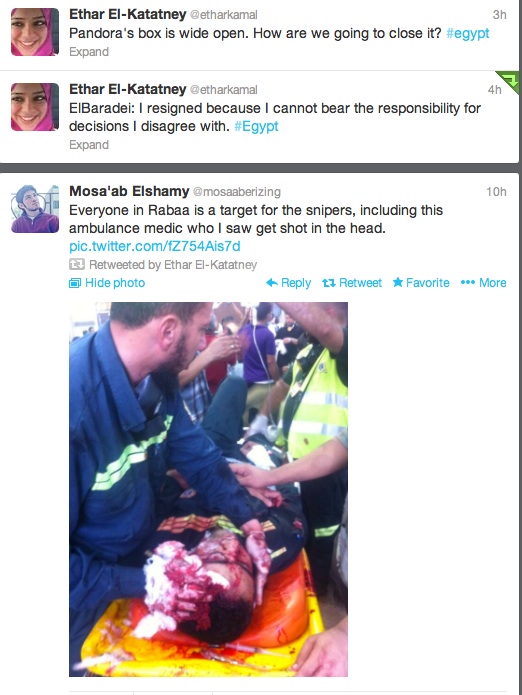
As Ethar El Katataney says in the tweet pictured above, "Pandora's Box is wide open. How are we going to close it?"

Q & A on Jaron Lanier's "Who Owns the Future?"

I spent the last week in Seattle, visiting my college roommate and good friend Bill Carleton (@Wac6 on Twitter). Bill is a lawyer with expertise in securities and intellectual property law, and lots of experience with start ups.

Bill Carleton
Over cigars and scotch, we had a long discussion/debate over the NSA revelations, which then morphed into a discussion of how private companies like Amazon, Google, and Facebook are amassing big data on all of us as well. Bill referred me to the work of Jaron Lanier, a technologist and author of You Are Not a Gadget. He also gave me his copy of Who Owns the Future?, which I read.

Lanier's argument, as I see it, is essentially this: these companies seduce the user with the lure of "free" services, and then mine all of us for valuable data. Lanier refers to these as "Siren Servers." The information we voluntarily cede has value, which those companies then convert into profits. But we users are never compensated for that valuable data. Lanier proposes a new model, which would acknowledge the monetary value that data has, so that each time we surrender such data, we receive a "nanopayment" to reflect that value.

Our resulting discussions led to this Q & A, which Bill has posted on his blog, William Carelton, Counselor @ Law.

I intend to expand on these preliminary thoughts on MOOCs in a future post here, but for now, this gives some sense of where I'm heading.