Showing posts with label Barack Obama. Show all posts

Wednesday, March 30, 2016

Orrin Hatch's Embarrassing New York Times Op-ed

This piece was originally published on History News Network

Senator Orrin Hatch took to the New York Times op-ed page to try to make the case for the Senate refusing to take up President Obama’s Supreme Court nominee.

It didn’t go well.

He starts by praising the late Antonin Scalia, implying that the rules should be different when replacing one of the “greatest jurists in our nation’s history.” The obvious reply is that it does not matter who the president is replacing. All openings on the Court are created equal.

Hatch then asserts that Obama has “contempt” for Scalia’s judicial philosophy. That may or may not be true, but in any case, it is irrelevant. When the electorate once again decisively elected Obama as president in 2012, it did not include an asterisk that said he could only replace justices with whom he agreed.

His next point is that when a senator, Obama opposed two of President Bush’s nominees. Again, this is irrelevant. No one is claiming that Hatch or any other Republican has to support Obama’s nominee—just that Judge Garland deserves a hearing and a vote. Republicans now are as free as Obama was then to oppose the confirmation of the nominee.

Hatch then moves on to even more absurdly irrelevant points, such as his assertion that Obama has “consistently exceeded the scope of his legitimate constitutional authority.” Putting aside how questionable that point is, what Hatch seems to be suggesting is that if senators think such a thing about a president, the president loses the right to exercise legitimate constitutional powers. The Constitution provides Congress with a remedy for a president who exceeds the scope of legitimate constitutional authority: impeachment. The simple fact that a Republican House has not taken up impeachment reveals Hatch’s point for the nonsense it is.

He then notes that the American people have chosen a Democratic president and Republican Senate. Fair enough. But that in no way leads to Hatch’s conclusion that the Senate can therefore ignore the nomination. What that “split decision” suggests is that the Democratic president should nominate a person who is not his political ideal, but a compromise candidate more acceptable to that Republican Senate. By choosing Merrick Garland, that is precisely what Obama has done. He is respecting the idea of checks and balances, both institutionally and politically. He did not chose someone who was a darling of the Democratic left, but someone who has (in the past) been repeatedly praised by Republicans, including Hatch himself. By refusing to even consider the nominee of the elected president, it is Hatch and the Senate Republicans who are not respecting the “split decision” of the American people, not the president. They are saying that the smaller subset of the American public that elected those Senate Republicans can simply ignore the decision of the entire national electorate in the last presidential election.

For an historian, perhaps the most offensive point Hatch makes is this: “Throughout its history, the Senate has never confirmed a nominee to fill a Supreme Court vacancy that occurred this late in a term-limited president’s time in office.” As a history teacher, I am used to the instinct unprepared undergraduates have to bolster a poor argument with the “throughout history” trick. I expect better of United States Senators.

Hatch shows his contempt for his readers with this tortured construction. To make his “throughout its history” line work, Hatch needs to make that history awfully short. He does that with the phrase “term-limited.” The 22nd Amendment, which imposes term limits on presidents, has only been in effect for 65 years. So this particular “throughout its history” means for 65 years—less than Hatch’s own life span.

As I pointed out in my previous piece on this subject, there has only been one other vacancy during that period that was “this late” in a president’s term: LBJ’s nomination of Abe Fortas in 1968. Yes, Fortas was not confirmed as Chief Justice. That nomination received a hearing, however, and a vote. It was not met with this disingenuous nonsense that “we never do this.” And as Hatch well knows, 1968 was one of the most contentious elections years in American history. Somehow, the Senate still did its job.

That leads to the next part of Hatch’s “kitchen sink” piece. He blames the “toxic presidential election” for Republican irresponsibility on this nomination. Anyone paying any attention knows that the current toxicity is almost entirely on his party’s side. Hillary Clinton and Bernie Sanders have mostly conducted their primary contest on a high, substantive level. Hatch calls this the “nastiest election year in recent memory.” He neglects to mention that the nastiness is almost entirely on the Republican side. By some inexplicable logic, the fact that the Republican Party is wallowing in the political gutter means that the Democratic president’s nominee for the Supreme Court should not be treated like any other nominee.

Lastly, Hatch notes: “I have witnessed firsthand the deterioration of the confirmation process. Neither party has clean hands on this front.” That is true. It is also true that what Hatch proposes as the responsible course of action is in fact an extraordinary escalation of the politicization of the nomination process far beyond what either party has done in the past. It shows contempt for the 2012 electorate that elected Barack Obama. It shows contempt for the president personally. It shows contempt for American history.

Nothing in Hatch’s piece changes any of that.

If Hatch and his fellow Republicans want to vote against Judge Garland, they have every right to do so. But they should stop being cowards. They should make a substantive argument against him, vote against him, and accept the political consequences of that vote. They should stop pretending that this reckless path they have chosen is anything but a desperate attempt to hold onto a Supreme Court majority.

Tuesday, February 16, 2016

Ted Cruz's Phony Supreme Court "Tradition"

[This post originally appeared on History News Network]

“It has been 80 years since a Supreme Court vacancy was nominated and confirmed in an election year. There is a long tradition that you don't do this in an election year."—Senator Ted Cruz 
If he honestly believes it is not legitimate to nominate and confirm a justice in an election year, Ted Cruz must hate the appointment of Chief Justice John Marshall. John Adams nominated him in January 1801, after he lost his re-election bid to Thomas Jefferson in the election of 1800. Adams was a lame duck in the truest sense of the term—he was serving out the remainder of his term after being repudiated by the voters. Yet he did not hesitate to fill the vacancy in the Supreme Court, and Marshall was confirmed by a lame duck Senate.

Perhaps the most striking irony of Cruz’s position (and increasingly the position of the entire Republican Party) is that this absurd debate is taking place over the replacement of Antonin Scalia. If there is one thing Scalia was known for, it is his originalist interpretation of the Constitution: it means what the founding generation said it meant. So is seems appropriate to ask: what did the Founders actually do in such circumstances?

In the final year of his presidency, George Washington had two nominations to the Supreme Court approved by the Senate. It was an election year and he was not running for reelection. It doesn’t get more "original intent" than that. Adams could easily have left the Supreme Court vacancy for Jefferson—who had already been elected, after all, and would take office in a matter of weeks—and didn’t. That seems as clear as it could be. The founders saw no impediment to a president in the final year--or even in the final weeks--of the presidency successfully appointing new justices to the Supreme Court.

What about Cruz's contention about the last 80 years? Even that does not hold up.

The facts are pretty simple. In the last 80 years there has only been one instance in which a president was in a position to nominate a justice in an election year and did not have the nominee confirmed. In 1968, LBJ’s nomination of Abe Fortas to be Chief Justice to succeed Earl Warren (and of Homer Thornberry to take the seat held by Fortas) was blocked in the Senate, but not because of some alleged “tradition.” Certainly there were Senators who wanted the next president to name a new justice. But the opposition to Fortas had everything to do with the specific nominee and specific objections to him (particularly charges of cronyism and inappropriate financial dealings). To the best of my knowledge, no one cited Cruz’s “tradition” to say it was not appropriate for Johnson to nominate someone, or that it would have been inappropriate to confirm anyone.

A second instance took place 28 years earlier. In 1940, FDR nominated Frank Murphy in January of that election year and he was confirmed that same month. There was no “tradition” blocking that election-year appointment. (This also shows that Cruz got the math wrong—this happened 76 years ago, not 80.) [Note: The morning after this post first appeared, Orrin Hatch spoke on NPR and amended the claim to no "term-limited" president had had a nominee confirmed in an election year--evidently an attempt to exempt FDR's confirmed nominee from the "tradition."]

So, there were two instances similar to the current situation in the last 80 years. In one case the nomination was rejected and in the other it wasn’t. To Ted Cruz, this constitutes “a long tradition that you don't do this.”

Ted Cruz’s invention of this alleged "tradition" that we don’t nominate and confirm Supreme Court justices in an election year would be laughable if so many supposedly responsible political leaders were not taking it seriously.

It is absurd on the face of it. If the Republicans in the Senate want to block any nominee Barack Obama sends them, they have the votes to do it. But they should stop hiding behind the obvious fiction that doing so is part of some “tradition.” It would be nothing but the raw, cynical use of their political power. This suggestion that Obama should not even nominate someone (both John Kasich and Marco Rubio said so in Saturday’s debate), or if he does, that the nominee should be rejected out of hand simply because of the timing (as the Senate Majority Leader and many Republican Senators are now saying), is simply silly. 

True conservatives don’t invent traditions. They work to protect existing ones. Our true tradition is that the president nominates and the Senate votes, regardless of when the vacancy occurs. 

The speed with which Cruz jumped to make this claim and with which so many others have fallen in line, speaks to the nihilistic radicalism that has infected today's Republican Party. Any position can be taken if it produces the correct result. Facts can be denied, “traditions” can be invented. The only value taken seriously is “does it work to our advantage?”

This tactic may well work politically. It has already had the effect of framing the debate as “Should Obama nominate someone?” That is truly extraordinary. The actual question should be “Should the Senate confirm Obama’s nominee?” That’s a legitimate debate, but it would put the focus on the nominee and that person’s qualifications. By hiding behind this phony “tradition,” Republicans are trying to avoid having to show that a given nominee should be rejected on the merits. In short, they don’t want to take responsibility for rejecting someone who—in all likelihood—will be eminently qualified for the job. That’s not statesmanship. It’s cowardice.

Wednesday, October 22, 2014

Can Obama Do in Iraq What Nixon and Ford Couldn't in Vietnam?

[Originally published on History News Network]

Practically every American intervention abroad since the 1960s has prompted comparisons to Vietnam. So it was hardly surprising when on October 8, in response to President Obama’s decision to expand the campaign against ISIS into Syria, Frederik Logevall and Gordon M. Goldstein authored an op-ed in the New York Times that asked “Will Syria Be Obama’s Vietnam?”

I’m not sure that’s the right question. The American concern over ISIS originated in Iraq, after all—an intervention that is now eleven years old. America’s air campaign against ISIS today reminds me less of the intervention that happened in Vietnam than the one that didn’t happen—in the spring of 1975.

This past June, when ISIS suddenly broke through America’s collective effort to forget about Iraq and seemed poised to take Baghdad, it was easy to wonder if we were about to witness a repeat of the fall of Saigon.

More than two years after the peace agreement that led to the withdrawal of American troops from Vietnam, a North Vietnamese offensive against South Vietnam met with little effective resistance, much like last June’s stories of Iraqi armed forces dropping their arms and failing to fight ISIS. Compare these passages from the New York Times coverage of the fall of Hue in March 1975 and Mosul in June 2014:
“By the thousands, the people are abandoning Hue…. The armed forces are also moving out, some by landing craft, some in military vehicles, some bundled into trucks with family members, furniture and food. No one seemed in the slightest doubt yesterday that Hue and the rest of the north were being left to the Communists.”
“Thousands of civilians fled south toward Baghdad…. The Iraqi Army apparently crumbled in the face of the militant assault, as soldiers dropped their weapons, shed their uniforms for civilian clothes and blended in with the fleeing masses…. ‘They took control of everything, and they are everywhere,’ said one soldier who fled the city.”
The political reaction this summer also eerily echoed the reaction to events of nearly 40 years ago.

In his Memoirs, Richard Nixon argued that he had won the Vietnam war and that American bombing of the North would have preserved the South Vietnamese government. It had survived for two years after the peace agreement. That meant Nixon’s Vietnamization had worked.

“When Congress reneged on our obligations under the agreements,” Nixon wrote, “the Communists predictably rushed in to fill the gap.” Nixon had privately assured South Vietnamese President Thieu that violations of the peace agreement by Hanoi would be met with renewed American bombing. But in June 1973, the Church-Case amendment forbade funding for any military operations in Vietnam. “The congressional bombing cutoff, coupled with the limitations placed on the President by the War Powers Resolution in November 1973, set off a string of events that led to the Communist takeover.” The war was “lost within a matter of months once Congress refused to fulfill our obligations,” Nixon said.

Henry Kissinger has also repeatedly argued that the peace agreement reached with Hanoi had secured the independence of South Vietnam, and that he and Nixon intended to use air power to thwart any North Vietnamese aggression against the South. But, he asserts, Watergate so weakened Nixon that they were unable to overcome the opposition of Congress. In a meeting with Singapore’s Lee Quan Yew on August 4, 1973, Kissinger said: “We have suffered a tragedy because of Watergate … We were going to bomb North Vietnam for a week, then go to Russia, then meet with [North Vietnam’s lead negotiator] Le Duc Tho. Congress made it impossible.”

Lewis Sorley, in his 1999 work A Better War: The Unexamined Victories and Final Tragedy of America’s Last Years in Vietnam, argued that “[t]here came a time when the war was won.” Due to the pacification efforts of Gen. Creighton Abrams, he writes, victory in in Vietnam “can probably best be dated in late 1970.” The countryside was pacified, and South Vietnamese forces were “capable of resisting aggression so long as America continued to provide logistical and financial support, and … renewed application of U.S. air and naval power should North Vietnam violate the terms of that agreement.”

The argument that continued American application of its air power against North Vietnam could have preserved South Vietnam has been thus been a staple of Vietnam War revisionism.

In June, Sen. John McCain made an argument about Iraq similar to the one that Nixon, Kissinger, and Sorley made about Vietnam:

"We had it won," McCain said. "Gen. [David] Petraeus had the conflict won, thanks to the surge. And if we had left a residual force behind, that we could have, we would not be facing the crisis we are today. Those are fundamental facts ... The fact is, we had the conflict won, and we had a stable government.” Sen. Lindsey Graham of South Carolina added: “There is no scenario where we can stop the bleeding in Iraq without American air power."

There are no do-overs in history, and no one can say for certain whether the renewed application of American air power after the 1973 peace agreement might have prevented the fall of Saigon—or if it did, for how long. But we are currently seeing why Congress sought to limit the executive branch’s options back in 1973.

The fear then was that, despite the peace agreement, Nixon and Kissinger would continue to fight a war that the country overwhelmingly wanted to be over. Kissinger’s repeated statements indicate that they in fact intended to do just that, not just in Vietnam but possibly in Cambodia, too. The Church-Case Amendment was how Congress expressed the national consensus against reviving the war.

Today, there seems little will in Congress to restrain the president’s war-making powers. If anything, the loudest voices have been those arguing for even greater military action. In response to such pressure, the president has already expanded the air war to Syria.

Just last week, McCain argued that “pinprick” airstrikes were proving ineffective, and called for further expansions of the war: “They’re winning, and we’re not,” McCain told CNN. “The Iraqis are not winning. The Peshmerga, the Kurds are not winning.” Thus, he argued, there was a need for “more boots on the ground … in the form of forward air controllers, special forces and other people like that…. You have to arm the Peshmerga … Buffer zone in Syria, no-fly zone, take on Bashar al Assad the same as we have ISIS.”

McCain’s vision of a renewed, ever-expanding war is precisely what Congress in 1973 meant to prevent Nixon and Kissinger from doing. After nearly a decade of war, Americans had decided that the fall of South Vietnam, Cambodia, and Laos would not be a mortal threat to American security.

Today, what stands between the United States and the full-scale revival of a war Americans thought was over is not Congress, but the president himself. Obama has repeatedly stated that he will not re-introduce American combat troops to Iraq, and he is trying to maintain a sense of balance about the nature of the threat: “While we have not yet detected specific plotting against our homeland, these terrorists have threatened America and our allies. And the United States will meet this threat with strength and resolve.”

McCain, however, is doing the opposite, hyping the threat the U.S. Back in June he said: “We are now facing an existential threat to the security of the United States of America.” Last week he said: “it is a threat to the United States of America if they are able to establish this caliphate.”

A September CNN public opinion poll suggests that Americans agree with McCain about the threat, while siding with Obama on the limits of the U.S. response. Ninety percent say ISIS represents a threat to the U.S., with 45 percent calling the threat “serious,” 22 percent saying it is “fairly serious” and 23 percent saying it is “somewhat serious.” (Two years after 9/11, in 2003, 49 percent considered Al Qaeda a “serious” threat to the U.S.) Seventy-one percent believe ISIS terrorists are already in the U.S. But at the same time, by a 61-38 margin, Americans oppose using American ground forces to defeat ISIS.

ISIS has succeeded in making Americans think that Iraq matters again, and that U.S. interests require its defeat, but it has not yet convinced them that it is worth Americans doing the fighting and dying. That's Obama's dilemma. If air power is not enough, does he take the chance that Iraq (or Syria) falls to ISIS, or does he break his promise?

In the spring of 1975, Congressional and public opinion meant that President Ford had little choice but to watch as the North Vietnamese Army rolled into Saigon. Nearly 40 years later, President Obama faces a far more difficult task: prevent the collapse of the Iraqi government (and, increasingly, the Syrian opposition) without fully reviving a war he spent years trying to end—all in the face of an opposition that is intent on proving that the Iraq war it supported was won until the president lost it.

Whether Obama will be able to keep his promise not to send American ground forces back to Iraq is very much an open question. Having taken the first step to save Iraq by applying American air power—what Nixon, Kissinger and Ford could not do in Vietnam—it may be increasingly hard to resist subsequent steps if air power proves to be not enough.

Tuesday, June 24, 2014

Maliki is the New Diem

Some people are talking coup d'etat in Iraq.

David Ignatius writes that "President Obama sensibly appears to be leaning toward an alternative policy that would replace Maliki with a less sectarian and polarizing prime minister."

The impulse to replace Maliki is understandable. Most observers of Iraq argue that he has played a large role in the growing sectarian divide between the majority Shi'ites and the minority Sunnis, and thus bears responsibility for the growth of ISIS in the north.

The unstated assumption, of course, is that another popularly elected, plausible leader could have governed differently and guided Iraq into a functioning democracy, and that now, the fact that elections produced Maliki should not stop the United States from maneuvering behind the scenes to get a more able (read "pliable") leader in his place. Then the United States can go about fixing Iraq.

President George W. Bush shakes hands with Iraqi Prime
Minister Nuri al-Maliki, July 25, 2006. Photo by
Kimberlee Hewitt, public domain via Wikimedia Commons
Perhaps. More likely is that the internal conditions in Iraq produced the kind of leader Maliki became. If that's the case, then a coup to oust Maliki will do no good at all. Instead, it is likely to make things worse.

There is certainly precedent for that. In the mid-1950s in South Vietnam, the Eisenhower administration sought a non-communist popular leader who would not be tarnished by associations with the departing French colonizers. It settled on Ngo Dinh Diem.

For about six years, Diem seemed the answer to American prayers. He created a separate South Vietnamese government as a counter to Ho Chi Minh's communist North. He led a fairly stable regime that served American interests in the region.

President Dwight D. Eisenhower shakes hands with South
Vietnamese President Ngo Dinh Diem, May 8 , 1957
U.S. National Archives and Records Administation
But then in 1960, the National Liberation Front began its offensive against Diem's government. As pressure grew, Diem grew more oppressive, in particularly cracking down on the majority Buddhists. By the fall of 1963, the American embassy and elements of the Kennedy administration decided that Diem was the problem and needed to go. American officials sent signals to South Vietnamese generals who then ousted and murdered Diem and his brother.

Ignatius effectively proposes that the United States do the same thing in Iraq today:
The people who will pull the plug on Maliki are Kurdish leader Massoud Barzani and other Iraqi kingmakers. The United States should push them to signal unmistakably that Maliki is finished…. Saudi Arabia wants Obama to announce that he opposes Maliki. It would be better just to move him out, rather than hold a news conference.
One can only hope that Obama resists such pressure. Things with Diem didn't work out well.

In a February 1, 1966 conversation with Sen. Eugene McCarthy, LBJ put it bluntly. Kennedy was told, he said, that Diem
was corrupt and he ought to be killed. So we killed him. We all got together and got a goddamn bunch of thugs and we went in and assassinated him. Now, we've really had no political stability since then.
The political instability that followed the Diem coup was a major contributing factor in LBJ's disastrous decision to Americanize the war in Vietnam.

The desire to replace Maliki is another example of the imperial attitude toward Iraq: America gets to decide when it is time for the leader to go. I have little doubt that if the United States determined to do so, it could mount a coup against Maliki.  But as always, the question is: what then?

As with the initial invasion, it is relatively easy to destroy. It is much harder to build. The United States can probably destroy Maliki if it so chooses. But can it build anything to replace him?

Friday, June 20, 2014

Somebody Told Us There'd Be Days Like These

With chaos returning to Iraq due to the growing power of ISIS (Islamic State of Iraq and Syria) in the north, the partisan divide over the American war there has resurfaced as well. Supporters of the war charge President Obama with losing Iraq because he withdrew American forces, while critics of the war fume at the gall of the architects of that disastrous war now posing as experts on the region.

Because the debate has been largely partisan, with Republicans and Democrats lining up rather predictably, there is a sense that this is merely a partisan dispute. It is not. Unfortunately, the partisan nature of the current debate makes it seem so.

Rather than go back to the 2003 debate, I decided to look back a little further--to the first war with Iraq in 1991, and the criticism of the George H. W. Bush administration for its refusal to go "on to Baghdad." Those Republican foreign policy leaders defended their decision by predicting undesirable outcomes--ones which we are now seeing come to fruition.

Re-reading the memoirs of Colin Powell (then Chair of the Joint Chiefs) and James Baker (then Secretary of State), it becomes immediately apparent that they foresaw today's events as the nearly inevitable outcome of a U.S. invasion to topple Saddam.

President George H. W. Bush, Secretary of State James Baker, National
Security Advisor Brent Scowcroft, Gen. Colin Powell, Jan. 15, 1991
U.S. National Archives and Records Administration
Writing in 1995, Gen. Powell quoted U.S. ambassador to Saudi Arabia, Charles Freeman, who wrote in a 1991 cable: "For a range of reasons, we cannot pursue Iraq's unconditional surrender and occupation by us. It is not in our interest to destroy Iraq or weaken it to the point that Iran and/or Syria are not constrained by it."

Baker also observed in 1995 that "as much as Saddam's neighbors wanted to see him gone, they feared that Iraq might fragment in unpredictable ways that would play into the hands of the mullahs in Iran, who could export their brands of Islamic fundamentalism with the help of Iraq's Shi'ites and quickly transform themselves into the dominant regional power."

Supporters of the war who now bemoan the growth of Iran's influence in Iraq have no one but themselves to blame. We were told it would be like this.

The current situation--a stable Kurdistan, ISIS in control of much of the Sunni-dominated areas, Shi'ites rallying to the defense of their holy sites--portends the possible partition of Iraq, either formally or de facto. That, too, was foreseen in 1991.

Powell: "It would not contribute to the stability we want in the Middle East to have Iraq fragmented into separate Sunni, Shia, and Kurd political entities. The only way to have avoided this outcome was to have undertaken a largely U.S. conquest and occupation of a remote nation of twenty million people."

The United States spent eight long years doing just that, occupying Iraq to keep it together. But that was never a sustainable long-term prospect. It went on too long as it was. Nevertheless, there are some neocons today suggesting that the United States never should have left Iraq.

Baker, who was known for his domestic political skills before he went to the State Department, knew that scenario was untenable: "Even if Saddam were captured and his regime toppled, American forces would still be confronted with the specter of a military occupation of indefinite duration to pacify the country and sustain a new government in power. The ensuing urban warfare would surely result in more casualties to American GIs than the war itself, thus creating a political firestorm at home."

Twenty years ago, these Republican statesmen predicted the situation we now see in Iraq. They warned anyone who would listen that an American intervention to overthrow Saddam Hussein would have undesirable consequences contrary to American interests, regardless of any specific actions the United States did or did not take in pursuit of that larger goal.

Keep in mind that they said these things would happen with their president in charge, with themselves making policy. They understood that there are forces that such an act would set loose which the United States could not control, no matter who was in office. They said all this long before anyone had ever even heard of Barack Obama. The idea that any specific act by the president is primarily responsible for the current state of affairs in Iraq is absurd on the face of it.

That won't stop people from saying so. But it should keep the rest of us from believing it.

Monday, June 16, 2014

Leadership and Interventionism Are Not the Same Thing

Robert Kagan has written a piece in the New Republic entitled "Superpowers Don't Get to Retire." In it, he bemoans what he perceives as America's retreat from its responsibility to preserve a liberal world order. Kagan argues: "Many Americans and their political leaders in both parties, including President Obama, have either forgotten or rejected the assumptions that undergirded American foreign policy for the past seven decades."

Kagan is correct that public attitudes towards America's role in the world have shifted recently, but he dramatically overstates the case when he posits a break with a 70-year tradition. He seems to equate "leadership" with military interventionism. Americans have rejected the latter, not the former.

What Kagan does not recognize is that the public's current aversion to military interventionism abroad is not only consistent with America's pre-World War II foreign policy, but with the golden age of leadership he praises.

Kagan's fundamental mistake is to think that the American people embraced military interventionism during and after World War II. They did not.

Americans have always been averse to military actions leading to large numbers of American casualties and extended occupations of hostile territory. In the two years before Pearl Harbor, Americans (even the so-called "interventionists") desperately clung to the idea that they could protect American interests merely by supplying the British (and later the Soviets) with the weapons to do the fighting.

While conventional wisdom suggests that Pearl Harbor changed all that, the reality is different. Even after the United States entered the war, it was reluctant to launch military operations that posed the threat of huge casualties. As David M. Kennedy has stated, this American predilection to avoid combat with Germany's forces in France led Stalin to conclude: "it looks like the Americans have decided to fight this war with American money and American machines and Russian men."

Even the major architect of the postwar order, Franklin Roosevelt, did not envision an America that would permanently station large numbers of U.S. soldiers abroad, much less deploy them on a regular basis. Yes, he did see the United States as the leading power in the new United Nations. But the point of having the so-called "Four Policemen" was to insure that the other three would be the ones to send soldiers to keep order in their respective spheres of interest. He imagined that the American role would be primarily in the form of naval and air power. "The United States will have to lead," FDR said of the UN, but its role would be to use "its good offices always to conciliate to help solve the differences which will arise between the others."

FDR, Churchill, and Stalin at Teheran
By Horton (Capt), War Office official photographer
[Public domain], via Wikimedia Commons
As the historian Warren Kimball has written, at the 1943 Teheran conference, when Stalin pressed him on how the United States would comport itself as one of the policemen, "FDR resorted to his prewar notion of sending only planes and ships from the United States to keep the peace in Europe." In FDR's mind, the United States would be primarily responsible for order in the western hemisphere, a role it had played for decades.

Even the so-called American declaration of cold war, the Truman Doctrine speech of March 1947, avoided the implication that American military forces would be deployed to uphold the doctrine. The speech simultaneously signaled to the world that the United States was both assuming some of Britain's responsibilities and had given up on the idea of cooperation with the Soviet Union. Nonetheless, Truman explicitly stated that the aid he was requesting would not be military: "I believe that our help should be primarily through economic and financial aid which is essential to economic stability and orderly political processes." Truman presented aid to Greece and Turkey as mere money to make good on the far larger investment of lives and treasure during World War II: "The assistance that I am recommending for Greece and Turkey amounts to little more than 1 tenth of 1 per cent of this investment. It is only common sense that we should safeguard this investment and make sure that it was not in vain."

The Korean War changed that by requiring quick American military intervention to prevent the collapse of South Korea in the summer of 1950, but when it bogged down into a stalemate after the Chinese intervention in November, the public quickly soured on the war. In January 1951, "49% thought the decision was a mistake, while 38% said it was not, and 13% had no opinion," according to Gallup. While those numbers fluctuated over the next two years, and more Americans thought the war was not a mistake whenever an end to the war was in sight, the American public in general did not support military actions that led to substantial American casualties and prolonged combat. The public's disillusionment with the war was one of the reasons that an increasingly unpopular President Truman decided not to run for reelection in 1952.

The next president, Dwight Eisenhower, moved quickly to end that war, and, more importantly, instituted a foreign policy that had at its core the principle of avoidance of any Korea-style wars in the future. Rather than engage in limited wars in every world hot spot, Eisenhower determined that such a course would bankrupt the country. He preferred "massive retaliation": the idea that a threat to essential American interests would be met with a nuclear threat, not a conventional response in kind. Even when the French faced defeat in Vietnam, Eisenhower refused to intervene, and never seriously considered deploying American troops to Vietnam.

While John Kennedy came into office criticizing that approach, pledging to "pay any price, bear any burden," the sobering experience of the Cuban missile crisis made him rethink that mindset. The cold war, he said in June 1963, imposed "burdens and dangers to so many countries," and specifically noted that the US and Soviet Union "bear the heaviest burdens." He spoke of the American aversion to war: "The United States, as the world knows, will never start a war. We do not want a war. We do not now expect a war. This generation of Americans has already had enough -- more than enough -- of war and hate and oppression."

While one may argue that Kennedy's policies led to the next American war in Vietnam under his successor Lyndon Johnson, it is also the case that Johnson sought to avoid a land war. Significantly, he looked first to use air power. Operation Rolling Thunder, the American air campaign against North Vietnam, was meant to forestall the need for American ground troops in large numbers. It was only after the clear failure of bombing to achieve American aims that Johnson escalated the war with more ground troops.

When that effort too proved futile, Richard Nixon again returned to air power as America's main instrument to maintain order abroad. His Vietnamizaion policy tried to balance the withdrawal of American troops with the deployment of increased air power. The "Nixon Doctrine," announced that henceforth "we shall furnish military and economic assistance when requested in accordance with our treaty commitments. But we shall look to the nation directly threatened to assume the primary responsibility of providing the manpower for its defense." In other words, America's friends should not expect American troops to do their fighting for them.

I'd argue that from Nixon up until George W. Bush's invasion of Iraq, that was American policy. Ronald Reagan, George H. W. Bush, and Bill Clinton all avoided open-ended military commitments of American troops (Clinton's air-only campaign against Serbia in 1999 is the best example).

Only the first war against Iraq in 1991 challenged that trend, and even that war involved a longer preliminary air campaign than a ground one: five weeks of bombing preceded the ground campaign, which lasted only 100 hours. According to Colin Powell, Bush had the Vietnam War in mind when he resisted the calls of "on to Baghdad." Bush "had promised the American people that Desert Storm would not become a Persian Gulf Vietnam," Powell writes in his memoir, "and he kept his promise." Within two weeks of the ceasefire, the 540,000 U.S. troops began their withdrawal from the Persian Gulf.

Even the American war in Afghanistan in 2001 was planned to keep the American "footprint" light, relying on American air power and the Afghan Northern Alliance to do much of the fighting. It was the invasion and prolonged occupation of Iraq beginning in 2003 that predictably soured Americans once again on the prospect of extended military engagements.

In sum, what Americans are experiencing now is not exceptional, but rather normal. In the aftermath of extended, costly military interventions leading to the loss of American lives, the American people revert to their historical aversion to solving problems by fighting in and occupying foreign states. That does not mean the United States ceases to be relevant, or ceases to lead. It simply means that Americans have been reminded once again that not every problem can be solved by an invasion, and that leadership is more than a reflexive application of American military might.

Thursday, June 12, 2014

Won't You Let Me Take You On a Sea Cruise?

Frank Bruni wrote a piece in the New York Times the other day, urging politicians to seek more solitude:
Take more time away. Spend more time alone. Trade the speechifying for solitude, which no longer gets anything close to the veneration it’s due, not just in politics but across many walks of life.
It’s in solitude that much of the sharpest thinking is done and many of the best ideas are hatched.
Coincidentally, I was reading about how FDR came up with the Lend-Lease program to aid Britain before the United States entered World War II, which makes Bruni's point perfectly.

Film title from an earlier FDR cruise,
from an FDR Library archival film
After winning his unprecedented third term the previous month, on December 2, 1940, FDR set off aboard the cruiser USS Tuscaloosa for a two-week cruise in the Caribbean.

Now, try to imagine the indignation today if Barack Obama slipped away from Washington (without any notice, no less!) for a two-week sea cruise.

FDR's cruise was not hidden, but rather
filmed for use in Navy recruiting
Not only did FDR not hesitate to take a vacation, he also did pretend it was a "working" vacation. He took a few close friends and advisors, and according to David Kaiser in his fine new book, No End Save Victory, they "spent the two weeks fishing, playing poker, sunning themselves and watching movies in the evening." Though the White House tried to portray it as a base-inspection tour, FDR "boasted proudly after his return that he did not read any of the working papers he had brought with him."

FDR fishing during a February 1940 southern cruise
That did not mean, however, that this was unproductive time.

FDR did read at least one item of business, what Winston Churchill called one of the most important letters he ever wrote--an appeal for the United States to drop its "cash and carry" requirement on aid to Britain because Britain no longer had the cash to pay.

Churchill later wrote:
Harry Hopkins [one of FDR's companions on the trip] told me later that Mr Roosevelt read and re-read this letter as he sat alone on his deck chair, and that for two days he did not seem to have reached any clear conclusion. He was plunged in intense thought, and brooded silently.
Hopkins said:
I didn't know for quite awhile what he was thinking about, but then--I began to get the idea that he was refueling, the way he so often does when he seems to be resting and care-free. So I didn't ask him any questions. Then, one evening, he suddenly came out with it--the whole program.
Two things are key here--FDR's own understanding that he needed to occasionally "refuel" in order to do his job well, and the understanding of his close friend and advisor Hopkins that FDR needed to be left alone to think. He allowed his boss the time to brood silently.

Could there be a better riposte to today's obsession with being busy for the sake of being busy, meeting for the sake of meeting? None of us bear the tremendous burdens that FDR had at the time--a world war to navigate the nation through--yet we are so prone to exaggerate our own importance and pose as too busy to "waste" time.

FDR was wiser. There was nothing wasteful about his sea cruise vacation. It was an investment, and one that paid off for the entire world.

Monday, October 28, 2013

To Still a Wackobird

"Simply because we were licked a hundred years before we started is no reason for us not to try to win."

I came across this line last week while re-reading To Kill a Mockingbird for my humanities class, and it struck me that it nicely captures the appeal of the GOP's recent quixotic effort to defund Obamacare that resulted in the government shutdown.

The line belongs to Atticus Finch, the attorney who takes on the legal defense of Tom Robinson, a black man falsely accused of rape. While I think it absurd to compare the principled nobility of that fictional act to the GOP's attempt to destroy the Affordable Care Act, the people who rallied to Texas Sen. Ted Cruz's cause don't. They believe in the nobility of the hopeless fight.

Harper Lee's novel retains its power more than 50 years after it was first published because it not only sends a clear message of condemnation of racial prejudice, but also tries to understand how whites came to hold those views, and turn those views back on them.

One of the lessons Atticus imparts to his children is the need to understand those we are tempted to dismiss or condemn: "You never really understand a person until you consider things from his point of view ... until you climb into his skin and walk around in it." On some level, Lee's novel is an exercise in just that.

Lee understands the depth of the racial prejudice she attacks, and knows how to reveal it. She adroitly connects her hero to the very quality ostensibly prized by the adherents of the South's "Lost Cause" mentality. When Atticus says it is worth fighting even when you know you will lose, Scout associates the sentiment with his Cousin Ike.
"Tell you, Atticus," Cousin Ike would say, "the Missouri Compromise was what licked us, but if I had to go through it agin I'd walk every step of the way there an' every step back just like I did it before an' furthermore we'd whip 'em this time ..."
Lee's brilliance consists of taking this mindset--the one that allowed defeated Confederates to salvage something from their defeat by focusing on the honor of making a good fight rather than the system of slavery that victory would have perpetuated--and transferring it to a character who stands for the rule of law and equal justice, rather than the Jim Crow oppression that the "Lost Cause" sentimentality made possible. Atticus tells Scout: "This time we aren't fighting the Yankees, we're fighting our friends." Lee neatly equates the proponents of white supremacy with the hated Northerners.

If what white Southerners truly value is a principled fight, Lee suggests, then they should stand with Atticus Finch. When they don't, they show what it is they truly value: the preservation of a system that institutionalizes their racial privilege. In some sense, Lee's novel revolves around that insight: the gap between the purported ideals and the ugly reality that they mask.

The power of the ideal is undeniable: persisting in the face of certain defeat is supposed to prove the purity of the motive. The honor of the fight is all.

This is the ideal embraced by the supporters of the shutdown strategy. More mainstream Republican figures said the idea was crazy and bound to fail (John McCain has memorably called Cruz a "wackobird"). To them, an effort that has no chance of success is foolish, even counterproductive. For others, however, the fact that it has no chance is precisely what recommends it.

In the aftermath of his utter lack of success, Cruz refused to express any regret. He called the fight a "courageous stand" and a "profile in courage." When asked if the fight was worth it, Rep. Michele Bachmann replied: "Absolutely.... What we did is fought the right fight.”

It is too easy to dismiss Cruz's shutdown advocacy as a stunt meant to propel him into the rank of 2016 presidential contenders. Of course it was that. The more important question is this: why did he think (evidently correctly) that it would have appeal among the Republican Tea Party base?

I would argue it is because he rightly recognized the appeal of the "Lost Cause" mentality.

In the course of American history, that concept is most closely associated with white Southerners, and while it may be more common among them, it is not at all uniquely "Southern." It is, however, an idea that has a special appeal to people who believe they have already lost the battle.

Many Southerners are Tea Party supporters, but not all Tea Party supporters are Southerners. During the shutdown, when a Tea Party protest at the White House brought out a Confederate battle flag, it was easy (too easy, really) to label all Tea Partiers as "neo-Confederates." Yes, race is an element here. It is not, however, everything. What is going on is more complex than that.

What we too loosely refer to as the "southern" mentality of the Tea Party is not geographic, but cultural. The Tea Party represents a subset of the larger culture: more white, more rural, more elderly, more traditional. The reason the apocalyptic rhetoric, the dig-in-your-heels style, and the confrontational (even anti-democratic) tactics appeal to Tea Party supporters is due to a simple fact: they see "their" America dying.

That's what they have in common with the Southern fire-eaters of the pre-Civil War era.

What many people don't understand about secession is that it was prompted merely by the fact of Lincoln's election, not anything concrete he had done--he had not even taken the office yet when eight states seceded. Secession was a response to what his election represented: the end of the Southern veto over national policy. Lincoln's election proved the northern states could elect a president without the aid of the southern states.

At that point, the fire-eaters decided the democratic game was over within the United States: they would always lose. Thus the only way to win, the only way to preserve "their" America, was to separate and create a new one in which they would be the permanent majority.

Today's GOP faces something similar. Demographic trends suggest that in the future, the GOP will not be able to remain the same ideologically and also be a majority party. Since it is not geographically defined the way the pro-slavery South was, the Tea Party core cannot secede in order to create a new majority (though "secession" and "nullification" have predictably enjoyed a recent resurgence in Tea Party circles).

One solution to this dilemma would be ideological change, which would require writing off the Tea Party. But the party is unwilling to take that step. Nothing shows that better than the way Speaker John Boehner abdicated all leadership in deference to the Tea Party caucus during the recent shutdown.

So what the party has been trying to do instead is change the rules so that they can control government without having to be an actual majority party.

That is what holds together the variety of the tactics used by the GOP since Obama's election in 2008. The abuse of the filibuster in the Senate has become a vehicle of minority veto, a way to say no to everything, to make a supermajority the new requirement for things that traditionally required a regular majority. The voter ID laws reflect the same desire to rig the outcome: if we cannot get a majority of the existing electorate, we can find a legal way to redefine the electorate and create an artificial majority.

The shutdown debacle was the same thing--unable to achieve the "correct" result through normal democratic process, Tea Partiers decided to hold the funding of government hostage to achieve its end of defunding Obamacare.

Why choose that issue? The term "Obamacare" has come to encompass everything they despise: the man himself, the electoral coalition that brought him to power and successfully kept him in office, the governmental philosophy he represents. It is the embodiment of their fear--bordering on certainty--that history is passing them by, that the America they believe in is passing away.

The desperation in the rhetoric is real. As long as cynics like Ted Cruz continue to pander to it, it will not diminish, and the Tea Party will remain politically relevant--and destructive.

Republicans are trying their best to frame the current divisions within the party as merely a matter of "tactics and strategies," as Cruz recently put it. It is not. It is a fight between those who think time is short and compromise is betrayal, and those who don't. The Tea Partiers are right, I think, if deep down they believe that they are fighting a losing battle. As long as they continue to demonstrate power within the GOP primaries, however, the racket of the wackobirds will go on and on.

Monday, September 9, 2013

Elevate the Debate

It hasn't exactly been an inspiring week for democratic discourse.

When President Obama decided to submit to Congress the question of military action against Syria, I wrote that he was doing the right thing in showing respect for process. I still believe that. But I also said that it was now up to Congress to "have a dignified and intelligent debate." So far, not so much.

There have been more lowlights than highlights. We've been treated to Rep. Jeff Duncan, Republican of South Carolina, embarrassing himself by launching an ad hominem attack on Secretary of State John Kerry in the guise of a question: “Is the power of the executive branch so intoxicating," Duncan said, "that you would abandon past caution in favor for pulling the trigger on a military response so quickly?”

This is not a statesman making an argument. This is a hack trying to score cheap political points.

Sen. John McCain, who has long supported miltiary intervention in Syria, makes the "credibility" argument. “If the Congress were to reject a resolution like this, after the president of the United States has already committed to action, the consequences would be catastrophic, in that the credibility of this country with friends and adversaries alike would be shredded,” McCain said.

The "credibility" case is perhaps the worst possible argument for military intervention. It amounts to saying that is better to do something stupid than take a chance that you might be seen as fickle or weak by deciding not to do the stupid thing you said you would do. If military strikes against Syria make sense as policy, proponents need to make that case, and not hide behind the absurd "credibility" argument that helped drag the United States into Vietnam.

Congressional Democrats have been no better.

Democratic Rep. Elijah Cummings of Maryland, who seems to want to vote yes in order to support a Democratic president, explained that over 90% of his constituents are against military action against Syria, and cited an exchange with a nurse, who opposes strikes:

"So I said, 'Do you understand there's chemical weapons?' She said, 'Folks have been using chemical weapons for a long time.'"

The problem is that the nurse is factually wrong. Since their widespread use in World War I and subsequent banning in 1925, such weapons have in fact rarely been used. Cummings either did not know that, or did not bother to correct her. Leadership sometimes means telling the people when they are wrong.

The whole idea behind a punitive military response against Syria is to reassert the idea that using such weapons is beyond the pale and insure that it does not now become commonplace. A member of Congress about to vote on the proposal should know that, and has no obligation to be swayed by the uninformed opinions of constituents.

Explaining why he was leaning against supporting military strikes against Syria, Rep. Gregory W. Meeks, Democrat of New York said: “I wasn’t elected just to go along to get along. I was elected to utilize my thought process and to determine what I think is in the best interest of my district.”

No, Rep. Meeks. When it comes to foreign policy, your job is not to think about "the best interest of my district." A congressional district does not have national security interests; the United States does. In these cases, you think as an American, not as the reflexive servant of your constituents. Meeks was trying to paint his fear of opposing constituent wishes as the political courage to be independent of the president, but instead makes himself look like a politician about to cravenly submit to the voters, rather than deciding what he thinks is right.

If members of Congress think the president is wrong, they should explain why, and not hide behind platitudes about constituent wishes or political independence. If they think he is right, they ought not to use "credibility" to avoid explaining exactly what American interests are at stake.

Perhaps in these hyper-partisan times, an elevated debate was too much to hope for. Rep. Tim Murphy, Republican of Pennsylvania, admitted that his constituents openly say that they oppose action against Syria simply because Obama is asking for it: “Generally, the calls are like this: ‘I can’t stand President Obama; don’t you dare go along with him,’” he said.

I've spent the last several years researching the American debate over involvement in World War II, so I inevitably tend to see this debate through that lens. That debate also had its low points, with demagoguery on both sides often drowning out more reasoned discourse. Some people no doubt opposed FDR's proposals simply because they came from "that man."

Nonetheless, there was a substantive debate over American policy, one that went on for 27 months. In those specific historical circumstances, the United States had the luxury of time. Since then--in part due to the difficulties FDR had in moving Congress toward intervention--presidents have often eschewed Congressional debates before taking action, citing the need for quick action. (It is likely also that they feared getting bogged down in precisely the kind of self-interested and often partisan Congressional posturing we've just seen).

Sadly, the last week shows why those previous presidents acted the way they did. If Congress wants to reassert its role in making foreign and military policy, if it wants to show that those previous presidents were wrong to act without Congress and that future presidents should follow Obama's example, today's Representatives and Senators need to elevate the debate to a level commensurate with the stakes. If they fail, they may squander their last best chance to show that the legislative branch can be a responsible partner in the making of American national security policy.

Monday, September 2, 2013

Bare Minimum

Since today is Labor Day, it seems appropriate to note that what was lost in last week's Eleazar David Melendez piece in the Huffington Post on the 1949 minimum wage increase was the role played by American labor.

Melendez rightly notes that the Truman administration and its conservative opponents compromised to reach the agreement to increase the minimum wage, but fails to note what motivated Truman and the Democrats to push so hard for the increase: the desire to fulfill at least one of its promises to labor.

Most union members made far more than the minimum wage in 1949--despite the fact that the final bill raised the minimum from 40 cents to 75, the average wage increase for most workers was only 5 to 10 cents, since most workers earned more than the minimum. Yet labor made it a priority because it saw itself as representing all workers, and believed that an increase in the minimum wage would have a ripple effect that would ultimately benefit all workers.

Politically, labor mattered. In his 1948 campaign, which many political observers dismissed as futile, Truman had run on a platform that pledged two major things to American labor: an increase in the minimum wage (which Truman had first asked for in 1945) and repeal of the anti-union Taft-Hartley Act of 1947, which passed the Republican-controlled Congress over Truman's veto.

In his State of the Union address in January 1949, Truman had called for repeal: "At present, working men and women of the Nation are discriminated against by a statute [the Taft-Hartley Act] that abridges their rights, curtails their constructive efforts, and hampers our system of free collective bargaining.... That act should be repealed!"

The reality, however, was that Truman lacked the votes to repeal the act, despite the fact that Democrats had regained control of Congress. The conservative coalition of Republicans and southern Democrats made it impossible.

What was possible was an increase in the minimum wage, and Democratic leaders in Congress quickly gave up on Taft-Hartley repeal and focused instead on that instead. While labor wanted $1 an hour, Truman had asked for "at least" 75 cents while also dramatically expanding (perhaps by 5 million) the number of workers covered by the law.

Predictably, conservatives tried to derail the proposal--but not by using today's obstructionist tactics. They actually proposed an alternative: limiting the increase to 65 cents an hour, indexing the wage to inflation, and eliminating the expansion of workers covered. Truman and the Democrats held firm on 75 cents, and Majority leader John McCormack made that number a matter of party loyalty, citing the 1948 platform. But they accepted the fact that they could not get both an increase in the wage and an increase in coverage, and accepted a bill that, in the short run, actually reduced the number of workers covered by the law.

That compromise led to a 361-35 vote in the House in favor of its version of the bill (this is the vote I referred to as "extraordinary" in the Melendez piece--he mistakenly attributed my statement to another 186 to 116 vote and has not responded to requests to correct the record).

What makes that vote extraordinary is that there were only 263 Democrats in the House. In other words, a large number of Republicans voted to increase the minimum wage.

Contrast that with today's conservative orthodoxy resolutely which resists any increase in the minimum wage. Sunday's Spartanburg Herald-Journal made a typical free-market argument: "The federal minimum wage is an artificial control on the market system" which "will only spur businesses to raise prices and cut jobs." They acknowledge that inflation has eroded the real value of the minimum wage, but reject the idea that this is any reason to increase it.

For the last 30 years, conservatives have resisted increases in the minimum wage, effectively lowering the wage when accounting for inflation. The minimum wage reached its height in 1967, when it was an inflation-adjusted $9.79 an hour. In fact, from 1962 to 1979, the minimum wage was always more than $9.00 an hour. Beginning in 1980 (coinciding with the start of the Reagan era), it began a steady decline, reaching an inflation-adjusted low of $6.59 in 2007.

That finally prompted the Democratically-controlled House in 2007 to pass an increase. They had the votes to do it alone, but a mere 6 years ago, 82 House Republicans also voted to increase the minimum wage. Can anyone imagine today's Republican House members casting such a vote?

The fact that President Obama's current proposal to increase the minimum wage to $9.00 an hour seems dead in the water is testimony to how reactionary today's Republicans have become. That rate today would only restore the minimum wage to where it was at the end of 1961. Despite a general nostalgia for the America of 50 years ago, in this one respect today's conservatives do not want to go back.

It is no coincidence that the erosion of the minimum wage parallels the decline of the power of the American labor movement. Ronald Reagan famously broke the air traffic controller strike in 1981, and it would be 9 years before the minimum wage increased again (it had increased 7 times in the previous 9 years). It is also no coincidence that the same period has seen a marked redistribution of wealth upward.

In 1979, when the minimum wage was an inflation-adjusted $9.33, the bottom 99% controlled 79.5% of the national wealth; in 2010, it was down to 64.6%.

Raising the minimum wage is one of the tools we have to try to maintain the kind of balanced economy that produces widespread prosperity. Today's conservative refusal to use that tool betrays an reactionary agenda that seeks to enhance, rather than alleviate, the trend toward maldistribution of wealth.

For all of its well-documented faults, American labor was a countervailing force that balanced the power of corporate America from the mid-1940s to the late-1970s, to the benefit of all Americans. Its decline in the decades since has led to a distorted, winner-take-all economy which is incapable of maintaining balanced, long-term economic growth. It may be impossible to revive the American labor movement, but it is imperative that we find a political substitute to play the role that unions once played in American political life.

Saturday, August 31, 2013

"Roll of the Dice"

Having just watched President Obama's statement on Syria, in which he both strongly made the case for his belief that the U.S. should launch punitive military strikes against the Assad regime and said he would ask for Congressional authorization to do so, I listened in amazement as the CNN commentators displayed just how poorly they know this president.

Wolf Blitzer kept repeating that this was a "roll of the dice," because by asking for Congressional authorization, Obama was taking the chance that the answer would be "no." In that case, he suggested, Obama risked looking weak.

In short, Blitzer et al simply could not seem to fathom that Obama may have been thinking of this decision in any terms other than the crassly political. It never seems to have occurred to them that he may believe that, however much he thinks that this is the right course of action, he had a responsibility to provide the time for the people's representatives to weigh in before acting. He may have actually believed a Congressional vote was the right and proper thing to do even if the Congress did not approve a military strike.

I've studied American political history and foreign policy long enough to know that presidents are never unaware of or unconcerned with the political ramifications of their military decisions. But that is not the same thing as saying that politics always trumps other considerations.

Over the last 30 to 40 years, we Americans have become so accustomed to presidents justifying the assertion of unilateral power to do nearly anything around the world by referring to their powers as "commander-in-chief" that a president refraining from doing so seems inexplicable, an irrational "roll of the dice."

President Obama made clear that he believes a strike is justified, even required, in this instance. But he did not therefore conclude that he had a unilateral right to do it. Perhaps if Congress refuses to grant the authority, he will act anyway. My guess is that he will not. My belief is that he was saying something that far too few Americans--in the media, and especially in Congress--seem to understand: process matters.

However important he thinks it is for the United States to make a statement that the use of chemical weapons cannot be tolerated, he does not think it more important than that basic principle. In our political life, we have accepted the corrosive idea that the only thing that matters is getting our way, process be damned.

The American system of government, if it is to work again, requires that all Americans recommit to the idea that the most important thing is not that we get our way by hook or by crook, but that we all agree to respect, abide by, and not abuse the process. If we have an election and our candidates and ideas lose, we do not then seek to subvert the result, or hold the government hostage in order to undo the results of that election.

If our ideas are rejected by the majority, we have every right to continue to believe them and advocate for them. But when we connive to impose them on others, when we run roughshod over the process in the name of achieving our desired result, we undermine the only thing that can ever make the system work.

In his deference to Congress today, President Obama has shown respect for process. Now it is up to Congress to show similar respect, have a dignified and intelligent debate, and face the responsibility of making its decision. If it does, regardless of the result, our system of government will be the stronger for it.

And with any luck, some members of Congress might even get in the habit of putting process over results. We can only hope.


Wednesday, August 14, 2013

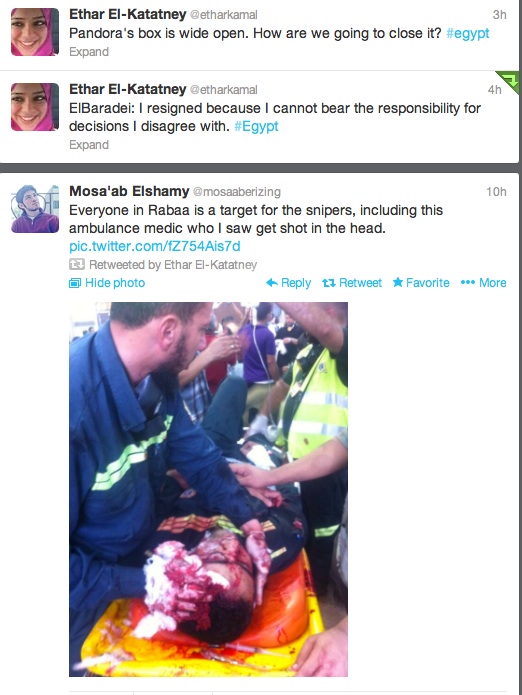
The Egyptian Tiananmen

In light of today's horrors in Egypt, Andrew Sullivan, Marc Lynch, and others are now calling for the cutting off of aid to Egypt. While that is the right thing to do now, it is a classic case of too little, too late.

The time to end the aid was after the coup, as the law required. By twisting itself in knots to pretend the coup was not a coup, the Obama administration signaled to the Egyptian generals that it valued its relationship with them more than the democratic process. The military no doubt took that as effectively a green light for today's events.

The administration allowed a simplistic idea of realpolitick to convince it that the worldy-wise way to approach the coup that removed Morsi from power was to finesse the situation. It would maintain its influence with the generals by showing that it had faith in their intentions to restore democracy. Lynch writes:
It seemed prudent to many in Washington to wait and see how things would play out, especially given the intense arguments of those defending what they considered popular revolution. It didn't help that neither the United States nor other outside actors knew quite what they wanted. Few particularly wanted to go to the mat for the Muslim Brotherhood or a Morsy restoration, and Washington quickly understood that this was not in the cards. But they also didn't want a return to military rule.
What Obama should have done instead was use the law requiring an aid cut-off as a way of pressuring the Egyptian military to restore quickly a legitimate government with a popular mandate. Obama would have had the excuse of saying that the coup left him with no options. Secretary of State Kerry then could have quietly made assurances that the aid would be immediately resumed once an elected government was in place.

Such a course would have given the administration actual leverage. Instead, its refusal to call a coup a coup sent precisely the wrong message.

What should have been clear before is now undeniable: when the military acted to remove Morsi from power, it was not acting on the popular will. It was rather exploiting the anti-Morsi protests to do what it wanted to do all along: decapitate the Muslim Brotherhood. By not objecting, the administration implied that it shared that objective. Was it really so odd that the Egyptian generals believed that if they could remove an elected president without consequences, they could also violently disperse protestors?

In academic discussions of American foreign policy, there is a common division between those who argue that U.S. diplomacy should be guided by ideals and those who say it should only serve material interests. In this case, that is a false choice. A stable Egypt, with real respect for democratic process, in which the Muslim Brotherhood has a stake in electoral politics, is in America's interest, but today that result seems sadly unlikely. By taking an allegedly "hard-headed" approach focused purely on interests, the Obama administration has served neither American ideals nor its interests.

As Ethar El Katataney says in the tweet pictured above, "Pandora's Box is wide open. How are we going to close it?"

Wednesday, June 19, 2013

The Enduring Appeal of the "Great Leader" Myth


“Some folks still don’t think I spend enough time with Congress. ‘Why don’t you get a drink with Mitch McConnell?’ they ask. Really? Why don’t you get a drink with Mitch McConnell?”

That's probably my favorite joke from President Obama's Correspondents Dinner routine, because it exposes the silliness of some of the criticism he's taken for his alleged lack of leadership. If only he'd spend more time schmoozing with members of Congress, then he might be able to get more legislation passed. Right. Mitch McConnell and John Boehner would just love to help the president with his agenda if only Obama would spend more time with them.

This kind of critique is all too common, because it is all too easy. Truly understanding the power dynamics of the House and the Senate, as well as the Republican and Democratic parties, is hard work. It is so much easier to just say the president hasn't led, and pretend there is some easy and obvious solution to the problem; say, schmoozing.

This is, of course, nothing new. I've been working for the last few weeks on the historical literature on the period before Pearl Harbor, and there are plenty of historians who level the same charge of lack of leadership at FDR. One of the more egregious examples comes from Stephen Ambrose. Charging that FDR's pre-Pearl Harbor policy was a "dismal failure," he slams Roosevelt for failing to convince the American people to go to war with Germany before the Japanese attack.

Ambrose notes that polls showed the public was against declaring war up until Dec. 7, 1941. "What the polls could not measure," Ambrose writes, "was how attitudes might have changed had presidential leadership been stiffer." Leaving aside the rather important question of whether or not FDR actually wanted all-out war with Germany at that point (and I am not convinced he did), Ambrose never says what "stiffer" leadership could have been.

Since the war in Europe began, FDR had consistently and persistently argued that a German victory in the war would be a disaster for the United States. He urged greater and greater assistance for Britain as its needs grew in order to prevent that outcome. No one who reads what FDR said over those two years can have any doubt that he made the strongest possible argument against Nazi Germany. Yet to Ambrose, somehow or other, FDR's leadership should have been "stiffer." There was something else he could have said that magically would have convinced the public to support a declaration of war on Hitler, even though Hitler had not declared war on the United States.

The flip side of this kind of thinking is similarly to attribute whatever political success a president enjoys to leadership--usually in the form of giving a speech. That was on full display last week in the New York Times on the 50th anniversary of JFK's civil rights speech. In a news piece entitled "When Presidential Words Led to Swift Action," Adam Clymer writes: "These days it is hard to imagine a single presidential speech changing history," but the civil rights speech is now seen as a "critical turning point." In an op-ed piece entitled "Kennedy’s Finest Moment," Peniel E. Joseph says it "might have been the single most important day in civil rights history."

Now, I think the speech is important--I always talk about it when teaching about the civil rights movement. But "most important day"? Or "critical turning point"? Hardly.

Clymer says the speech "led quickly and directly to important changes." In fact, the speech did neither.

The Civil Rights Act, which JFK proposed that night, was passed more than a year later (MLK's March on Washington two months after JFK's speech was in response to the lack of quick movement in Congress). That legislation's passage was not directly due to the speech, but the efforts of LBJ (who was aided greatly by the fact that JFK's death allowed him to portray the legislation as a tribute to the martyred president) and bipartisan support in Congress.

More importantly, what both pieces neglect is that the speech is not a good example of presidential leadership (at least not in the sense that they mean it). By the time the Civil Rights Act became law, ten years had passed since the Supreme Court's Brown v. Board of Education case stated that separate is inherently unequal. That decade was marked primarily not by presidential leadership, but by grassroots organizing and protest. Before giving that speech, JFK had spent two and half years riding the fence on civil rights, while sit-ins and freedom rides and demonstrations relentlessly pushed the issue into the public consciousness. What forced JFK at last to take sides was the movement, specifically recent events in Birmingham. Whatever you call that, it wasn't "leadership."

Presidents do not make history on their own, however much some people like to pretend they do. FDR famously once told a group of supporters that he agreed with what they wanted him to do. "Now make me do it," he added.

That's how democracy works. Leaders have no magic wands that they can wave. The people have to demand that it get done, and create the political pressure. In June 1940, Eleanor Roosevelt met with some supporters who were frustrated with the lack of progressive reform in recent years. She said to them:
If you believe in democracy, you have got to work for the majority and have got to be willing to wait for it. I have done organization work practically all my life and I know that until you organize a thing down to the precincts and get a real demand from there up, there is not that majority demand for the thing and you cannot get it. You come away with the feeling that the President is willing to lead, but never too far in advance of public opinion, because that is the way things work in a democracy as understood by a politician and a democrat.
The people who don't understand that are often neither politicians nor democrats, but ideologues who are so utterly convinced of the virtue of their positions that they cannot imagine that anything other than incompetence or malice could be standing in the way of achieving their self-evidently desirable goals. They want the leader to simply do it, already!

This idea of "great person" leadership is not only mistaken, it is profoundly undemocratic. When critics bellyache about the lack of leadership, they are often betraying an authoritarian impulse to impose their own views on others, without doing the hard work of convincing others that it is the right way to go. You've got to be willing to wait for it. As frustrating as that work can be, it certainly beats dictatorship by the ideologically certain.

Yes, presidents matter. Speeches matter. Stating where one stands matters. But mostly, change comes when people decide that change matters.

Thursday, May 23, 2013

"Read the History"

Last week, a reporter asked President Obama the inevitable question: was his administration like that of Richard Nixon? That the question was so predictable made it no less absurd. "I’ll let you guys engage in those comparisons," Obama replied. "And you can go ahead and read the history, I think, and draw your own conclusions."

Of course a historian will like his advice: "read the history." The president's problem is that people do not know the history of Watergate and are unlikely to read it. (For those who are interested, Elizabeth Drew has a nice summary of Nixon's misdeeds.)

Since the early 1970s, almost every case of any kind of misbehavior in the political realm gets saddled with the Watergate comparison, and just about every comparison to Nixon and Watergate ends up being silly (for example, the case of Wisconsin Governor Scott Walker's phony Koch brothers tape as I noted here).

Why do we repeatedly do this? The problem, as I see it, is in the name: "Watergate." By assigning that single word to the Nixon administration's many crimes, we reduce them to something small and petty. They were anything but that, but most of us don't know it.

For Americans born after the 1960s, the term "Watergate" is likely little more than a synonym for political scandal.  Even those (like me) with some memory of the scandal are unlikely to remember more than a few basic facts: a group of thugs associated with the Nixon re-election campaign stupidly broke into the Democratic headquarters and got caught, Nixon panicked, tried to cover it up, and then was done in by the foolish efforts to cover-up an incident that, in the end, was really no big deal.

In a perfect example of that flawed conventional wisdom,  Newt Gingrich, when asked about the president's recent troubles, said: "It's always the cover-up that kills you."

That's simply wrong, but you hear it whenever there is a new Washington "scandal."

What it neglects is this: Nixon had plenty he needed to cover up. I've never thought that Nixon ordered the break-in at the Watergate hotel, and to this day no definitive evidence shows that he did. The important fact, however, is that that does not matter. Nixon's motive for the cover up was that the men involved in the break-in were involved in plenty of other nefarious activities, ones that Nixon did know about and often did order. The burglars answered to people close to Nixon who had direct knowledge of the president's involvement in numerous criminal activities.

Nixon's plan was to throw the burglars under the bus, but bribe them to keep quiet. It didn't work. They talked, and then others began to talk too--most notably Nixon's lawyer, John Dean. (Dean is on record saying that nothing going on today approaches the seriousness of the Nixon years.) That led to the revelations of widespread abuse of power that finally forced Nixon from power.

The Nixon of the common understanding of Watergate was stupid, or crazy, or both. I reject that interpretation. Nixon was many things, but stupid is not one of them. As the pressures of the Watergate scandal grew, one can make the case that he may have become mentally unhinged. But the actions that forced him from office were done when Nixon was in full command of his faculties. They reflected who he was. One's actions usually do.

Perhaps we will find that a secretly Nixonian Obama gave orders that the IRS screw anyone associated with the Tea Party (if so, they did a terrible job of it--none of the organizations subjected to extra scrutiny were denied tax-exempt status). Maybe we'll learn that he became so obsessed with leaks that he suggested poisoning reporters, as Nixon suggested should be done to Jack Anderson.

But it is far more likely that we'll find that this brouhaha has been just another uninformed use of the Watergate analogy. If we read the history.