Wednesday, August 14, 2013

The Egyptian Tiananmen

In light of today's horrors in Egypt, Andrew Sullivan, Marc Lynch, and others are now calling for the cutting off of aid to Egypt. While that is the right thing to do now, it is a classic case of too little, too late.

The time to end the aid was after the coup, as the law required. By twisting itself in knots to pretend the coup was not a coup, the Obama administration signaled to the Egyptian generals that it valued its relationship with them more than the democratic process. The military no doubt took that as effectively a green light for today's events.

The administration allowed a simplistic idea of realpolitick to convince it that the worldy-wise way to approach the coup that removed Morsi from power was to finesse the situation. It would maintain its influence with the generals by showing that it had faith in their intentions to restore democracy. Lynch writes:
It seemed prudent to many in Washington to wait and see how things would play out, especially given the intense arguments of those defending what they considered popular revolution. It didn't help that neither the United States nor other outside actors knew quite what they wanted. Few particularly wanted to go to the mat for the Muslim Brotherhood or a Morsy restoration, and Washington quickly understood that this was not in the cards. But they also didn't want a return to military rule.
What Obama should have done instead was use the law requiring an aid cut-off as a way of pressuring the Egyptian military to restore quickly a legitimate government with a popular mandate. Obama would have had the excuse of saying that the coup left him with no options. Secretary of State Kerry then could have quietly made assurances that the aid would be immediately resumed once an elected government was in place.

Such a course would have given the administration actual leverage. Instead, its refusal to call a coup a coup sent precisely the wrong message.

What should have been clear before is now undeniable: when the military acted to remove Morsi from power, it was not acting on the popular will. It was rather exploiting the anti-Morsi protests to do what it wanted to do all along: decapitate the Muslim Brotherhood. By not objecting, the administration implied that it shared that objective. Was it really so odd that the Egyptian generals believed that if they could remove an elected president without consequences, they could also violently disperse protestors?

In academic discussions of American foreign policy, there is a common division between those who argue that U.S. diplomacy should be guided by ideals and those who say it should only serve material interests. In this case, that is a false choice. A stable Egypt, with real respect for democratic process, in which the Muslim Brotherhood has a stake in electoral politics, is in America's interest, but today that result seems sadly unlikely. By taking an allegedly "hard-headed" approach focused purely on interests, the Obama administration has served neither American ideals nor its interests.

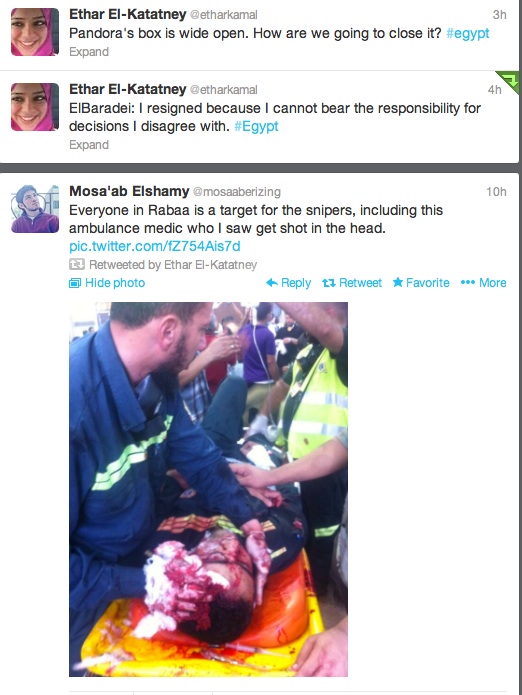
As Ethar El Katataney says in the tweet pictured above, "Pandora's Box is wide open. How are we going to close it?"

Q & A on Jaron Lanier's "Who Owns the Future?"

I spent the last week in Seattle, visiting my college roommate and good friend Bill Carleton (@Wac6 on Twitter). Bill is a lawyer with expertise in securities and intellectual property law, and lots of experience with start ups.

Bill Carleton
Over cigars and scotch, we had a long discussion/debate over the NSA revelations, which then morphed into a discussion of how private companies like Amazon, Google, and Facebook are amassing big data on all of us as well. Bill referred me to the work of Jaron Lanier, a technologist and author of You Are Not a Gadget. He also gave me his copy of Who Owns the Future?, which I read.

Lanier's argument, as I see it, is essentially this: these companies seduce the user with the lure of "free" services, and then mine all of us for valuable data. Lanier refers to these as "Siren Servers." The information we voluntarily cede has value, which those companies then convert into profits. But we users are never compensated for that valuable data. Lanier proposes a new model, which would acknowledge the monetary value that data has, so that each time we surrender such data, we receive a "nanopayment" to reflect that value.

Our resulting discussions led to this Q & A, which Bill has posted on his blog, William Carelton, Counselor @ Law.

I intend to expand on these preliminary thoughts on MOOCs in a future post here, but for now, this gives some sense of where I'm heading.

Thursday, August 1, 2013

British Diplomacy and Royal Baby Mania

A new heir to a powerless throne was born last week, and a portion of the American public went into a collective tizzy over it. Predictably, another portion went into a tizzy over that, and muttered some variant of "George Washington [or some other Founder] must be rolling over in this grave."

As an American of Irish descent, I don't go in much for British royalty worship, but I suppose it is no more harmful than many other types of American celebrity adoration. But these two types of responses got me thinking about the nature of the American relationship with the former mother country.

For the vast majority of living Americans, it has always been the "special relationship," but that is actually of fairly recent vintage, forged in the crucible of World War II (and visually captured by this image of FDR and Churchill, meeting on a British naval vessel in August 1941, singing "Onward Christian Soldiers").

As so often happens, the memory of the living is incomplete.

One need not go back to the Revolution to find Americans who would be appalled at the sight of last week's American attention to a British royal birth. For at least the first century after American independence, Britain was the enemy of the United States: at war from 1812 to 1815, at odds for most the next few decades (including a near-war over Oregon in 1846), no other country caused 19th century American presidents more consternation than Britain.

Not even fighting on the same side in the first World War completely changed that. American Anglophobia was still alive as FDR and Churchill were meeting in the summer of 1941. The United States was in the midst of the Great Debate over the extent of American involvement in World War II. Pearl Harbor lay months in the future, and isolationists continued to argue that the United States should not enter the war. There were plenty of Americans who rejected the idea that there was any "special relationship," or that American interests overlapped much with those of Great Britain.

While their arguments against American involvement were numerous, one is particularly relevant here: it would mean fighting for British imperialism. In April 1941, in a nationally broadcast radio debate, Fay Bennett, executive secretary of the Youth Committee Against War said: "if you have any faith that the British Empire is going to bring peace and democracy to the world, I would like one bit of evidence to that effect."

A particular focus of this line of argument was British rule in India. Gandhi's independence movement had put the British in the awkward position of fighting German imperialism in Europe while defending their own in Asia. As Churchill later said in November 1942, "we mean to hold our own. I have not become the King's First Minister in order to preside over the liquidation of the British Empire."

The isolationist argument that America should not assist British imperialism was so common that an interventionist anticipated it in one debate: “I don’t think the present regime in England … and even what is going on in India—I suppose some of you people will want to bring that up—can in any way compare to the world we would have to live in if Hitler were the victor.”

The defenders of aid to Britain often resorted not to appeals to any "special relationship," but instead fell back on the idea that the British were simply the lesser of evils in this fight.

Pearl Harbor ended all that, as the German declaration of war brought the U.S. fully into the war on the same side as Great Britain, and Churchill came to the U.S. and lived at the White House for several weeks.

That result was no accident, however. It was the product of over 40 years of wise diplomacy by the British Foreign Office, which surveyed the world situation in the 1890s and made a conscious decision to cultivate American friendship. It saw three rising powers in the world: the U.S., Germany, and Japan. It could not successfully oppose all three, so Britain choose to accommodate the rise of American power and hoped to enlist it in the fight to thwart the other two. In December 1941, Britain saw that decision pay off magnificently, as America joined forces with Britain to defeat the designs of Germany and Japan.

I'm quite confident that officials of the British Foreign Office never anticipated American "royal baby mania" in 2013. In some sense, however, the unthinking American adoption of the British royal family witnessed last week is also an unintended product of their diplomacy.

Saturday, July 20, 2013

Orwell on Hitler

A great writer will surprise you.

For the last few months, I have been intermittently dipping into George Orwell's collected Essays. A few pieces have seemed rather dated, most have been interesting and enlightening, and not a few (like his extended musings on Dickens) are extraordinary.

The other night, I was reading in bed, finishing his review of Henry Miller's Tropic of Cancer (which is less a review than an examination of the role of literature now that World War II had come), and I turned the page to find that the next piece was titled "Review of Mein Kampf, by Adolf Hitler, unabridged translation" from March 1940.

"Well," I thought, "THIS should be interesting." I decided I could stay up reading just a little longer.

The first half deals mostly with how Hitler's image in Britain had changed over the last year. Then Orwell writes something that stopped me dead in my tracks:
"I should like to put it on record that I have never been able to dislike Hitler."
I reread the sentence, certain that I had missed something, but I hadn't. How could Orwell, with his unremitting hatred of totalitarianism, not hate Hitler? Orwell spends the second half of the essay persuasively explaining himself, but the brief answer is this: simply hating Hitler is easy, lazy, and self-defeating.

Precisely because he despises totalitarianism, Orwell is interested in the reason that Germans have accepted Hitler's leadership. He starts by recognizing that Hitler's political success was due in part to the "attraction of his own personality." Orwell writes that while he has thought that, given the chance, "I would certainly kill him," he would "feel no personal animosity" because "there is something deeply appealing about him." That is, really, the horrible truth. Hitler otherwise never would have become so powerful.

Orwell argues that it is Hitler's portrayal of himself as a kind of underdog that is so affecting:
He is the martyr, the victim, Prometheus chained to the rock, the self-sacrificing hero who fights single-handed against impossible odds.... The attraction of such a pose is of course enormous; half the films that one sees turn upon some such theme.
What makes Orwell's analysis so powerful is not simply that he identifies the source of Hitler's appeal, but that he admits that he himself is susceptible to it. He does not separate himself from (and thereby elevate himself above) the Germans who support Hitler. He identifies with and understands them.


Even more, he gives the devil his due. It is not merely that Hitler's personality can be attractive, Orwell argues. Hitler's appeal is also due to his ideology, which has at its foundation an important insight:
Also he has grasped the falsity of the hedonistic attitude toward life.... Hitler, because in his own joyless mind he feels it with exceptional strength, knows that human beings don't only want comfort, safety, short working-hours, hygiene, birth control and, in general, common sense; they also, at least intermittently, want struggle and self-sacrifice, not to mention drums, flags and loyalty-parades.
It goes without saying that Orwell finds Hitler's ideology repugnant; why then say that "Fascism and Nazism are psychologically far sounder than any hedonistic conception of life"? It is precisely because he finds it so horrific that he must recognize its power. Few people of his time knew better than Orwell the awful places that totalitarianism would soon lead humanity. He was able to see where it would lead because he understood its psychological power. He did not unthinkingly dismiss it as evil, he did not live in denial. He grappled with it.

In a passage I suspect will resonate with most of my friends who are parents, Orwell writes:
The Socialist who finds his children playing with soldiers is usually upset, but he is never able to think of a substitute for the tin soldiers; tin pacifists somehow won't do.
His point is not that the parent need approve or encourage that part of the child's make-up, but rather that it is foolish and unproductive to ignore or deny its reality.

Orwell knew that merely demonizing the enemy is in fact doing the enemy a favor. Understanding the appeal of your enemy and your enemy's ideas does not mean abandoning one's own views, or excusing those of the enemy. It is, instead, key to defeating the enemy.

Orwell believed that Hitler's way was bound to produce "years of slaughter and starvation" for Germany. At that point, he writes, "Greatest happiness of the greatest number" would once again be "a good slogan." But, he says,
at this moment, "Better an end with horror than a horror without end" is a winner. Now that we are fighting against the man who coined it, we ought not to underrate its emotional appeal.
That's a lesson we all can take from Orwell's surprising take on Hitler.

Wednesday, June 19, 2013

The Enduring Appeal of the "Great Leader" Myth


“Some folks still don’t think I spend enough time with Congress. ‘Why don’t you get a drink with Mitch McConnell?’ they ask. Really? Why don’t you get a drink with Mitch McConnell?”

That's probably my favorite joke from President Obama's Correspondents Dinner routine, because it exposes the silliness of some of the criticism he's taken for his alleged lack of leadership. If only he'd spend more time schmoozing with members of Congress, then he might be able to get more legislation passed. Right. Mitch McConnell and John Boehner would just love to help the president with his agenda if only Obama would spend more time with them.

This kind of critique is all too common, because it is all too easy. Truly understanding the power dynamics of the House and the Senate, as well as the Republican and Democratic parties, is hard work. It is so much easier to just say the president hasn't led, and pretend there is some easy and obvious solution to the problem; say, schmoozing.

This is, of course, nothing new. I've been working for the last few weeks on the historical literature on the period before Pearl Harbor, and there are plenty of historians who level the same charge of lack of leadership at FDR. One of the more egregious examples comes from Stephen Ambrose. Charging that FDR's pre-Pearl Harbor policy was a "dismal failure," he slams Roosevelt for failing to convince the American people to go to war with Germany before the Japanese attack.

Ambrose notes that polls showed the public was against declaring war up until Dec. 7, 1941. "What the polls could not measure," Ambrose writes, "was how attitudes might have changed had presidential leadership been stiffer." Leaving aside the rather important question of whether or not FDR actually wanted all-out war with Germany at that point (and I am not convinced he did), Ambrose never says what "stiffer" leadership could have been.

Since the war in Europe began, FDR had consistently and persistently argued that a German victory in the war would be a disaster for the United States. He urged greater and greater assistance for Britain as its needs grew in order to prevent that outcome. No one who reads what FDR said over those two years can have any doubt that he made the strongest possible argument against Nazi Germany. Yet to Ambrose, somehow or other, FDR's leadership should have been "stiffer." There was something else he could have said that magically would have convinced the public to support a declaration of war on Hitler, even though Hitler had not declared war on the United States.

The flip side of this kind of thinking is similarly to attribute whatever political success a president enjoys to leadership--usually in the form of giving a speech. That was on full display last week in the New York Times on the 50th anniversary of JFK's civil rights speech. In a news piece entitled "When Presidential Words Led to Swift Action," Adam Clymer writes: "These days it is hard to imagine a single presidential speech changing history," but the civil rights speech is now seen as a "critical turning point." In an op-ed piece entitled "Kennedy’s Finest Moment," Peniel E. Joseph says it "might have been the single most important day in civil rights history."

Now, I think the speech is important--I always talk about it when teaching about the civil rights movement. But "most important day"? Or "critical turning point"? Hardly.

Clymer says the speech "led quickly and directly to important changes." In fact, the speech did neither.

The Civil Rights Act, which JFK proposed that night, was passed more than a year later (MLK's March on Washington two months after JFK's speech was in response to the lack of quick movement in Congress). That legislation's passage was not directly due to the speech, but the efforts of LBJ (who was aided greatly by the fact that JFK's death allowed him to portray the legislation as a tribute to the martyred president) and bipartisan support in Congress.

More importantly, what both pieces neglect is that the speech is not a good example of presidential leadership (at least not in the sense that they mean it). By the time the Civil Rights Act became law, ten years had passed since the Supreme Court's Brown v. Board of Education case stated that separate is inherently unequal. That decade was marked primarily not by presidential leadership, but by grassroots organizing and protest. Before giving that speech, JFK had spent two and half years riding the fence on civil rights, while sit-ins and freedom rides and demonstrations relentlessly pushed the issue into the public consciousness. What forced JFK at last to take sides was the movement, specifically recent events in Birmingham. Whatever you call that, it wasn't "leadership."

Presidents do not make history on their own, however much some people like to pretend they do. FDR famously once told a group of supporters that he agreed with what they wanted him to do. "Now make me do it," he added.

That's how democracy works. Leaders have no magic wands that they can wave. The people have to demand that it get done, and create the political pressure. In June 1940, Eleanor Roosevelt met with some supporters who were frustrated with the lack of progressive reform in recent years. She said to them:
If you believe in democracy, you have got to work for the majority and have got to be willing to wait for it. I have done organization work practically all my life and I know that until you organize a thing down to the precincts and get a real demand from there up, there is not that majority demand for the thing and you cannot get it. You come away with the feeling that the President is willing to lead, but never too far in advance of public opinion, because that is the way things work in a democracy as understood by a politician and a democrat.
The people who don't understand that are often neither politicians nor democrats, but ideologues who are so utterly convinced of the virtue of their positions that they cannot imagine that anything other than incompetence or malice could be standing in the way of achieving their self-evidently desirable goals. They want the leader to simply do it, already!

This idea of "great person" leadership is not only mistaken, it is profoundly undemocratic. When critics bellyache about the lack of leadership, they are often betraying an authoritarian impulse to impose their own views on others, without doing the hard work of convincing others that it is the right way to go. You've got to be willing to wait for it. As frustrating as that work can be, it certainly beats dictatorship by the ideologically certain.

Yes, presidents matter. Speeches matter. Stating where one stands matters. But mostly, change comes when people decide that change matters.

Monday, May 27, 2013

Three-Fifths Understanding


The infamous three-fifths clause is back in the news.

The Twittersphere exploded last Wednesday when the GOP nominee for Lt. Governor of Virginia, E. W. Jackson, made this comment:

“Rev. [Charles Wallace] Smith must not have understood the 3/5ths clause was an anti-slavery amendment. Its purpose was to limit the voting power of slave-holding states.”

Jackson has made all sorts of interesting comments, so it is not surprising that some people put the worst possible interpretation on his remarks, suggesting that he was defending the clause. But Jackson was not entirely wrong.

E.W. Jackson
The clause is probably both one of the most well-known and most misunderstood clauses in the Constitution:
Representatives and direct Taxes shall be apportioned among the several States which may be included within this Union, according to their respective Numbers, which shall be determined by adding to the whole Number of free Persons, including those bound to Service for a Term of Years, and excluding Indians not taxed, three fifths of all other Persons.
In the popular mind, the clause has come to mean that the Constitution considered a slave to be three-fifths of a person, and in a metaphorical sense, that is true. That is not, however, what motivated the clause.

What was actually at issue here was how to deal with the reality that the new government would be a union of states, some of which had done away with slavery (or were in the process of doing so; most northern states did away with slavery gradually) and others which had large numbers of slaves. Since the new House of Representatives was to apportion representatives based on population, the framers needed to decide whether the slave population would be taken into account.

From a modern perspective, it seems simple: just add up the total number of people (or "Persons" in the Constitution's language). In this case (as in so many others for the next six decades), slavery took what should have been an easy question and made it a complicated one. In a legal sense, slaves were property, not "Persons." So northerners argued that they should not be counted for representation at all.

That's right: the anti-slavery portion of the country argued that slaves should not be three-fifths of a person, but zero-fifths of a person. To add to the absurdity, southerners--who otherwise insisted that slaves were not "Persons" any more than horses were--argued that in this instance, and this instance alone, slaves should be counted as whole Persons, equal to every white man, woman, and child.

Each section adopted the convenient argument which would enhance its political power. To get past the impasse, they compromised on three-fifths. So compared to the southern position, Jackson is correct: three-fifths is relatively anti-slavery in that it gave slave states less power in the House than they would have had if slaves were counted as whole Persons. Compared to the northern position, however, three-fifths can only be seen as pro-slavery, since it allowed white southerners to count 60% of their slaves as both Persons and property.

The important question, however, is not whether the three-fifths clause was pro- or anti-slavery. What matters is what this story tells us about the nature of compromise in the American political system.

How do we evaluate such a compromise? From today's perspective, most of us are understandably appalled, and shudder when someone fails to be.

For example, three months ago, James Wagner, the president of Emory, stepped into it. He called "the agreement to count three-fifths of the slave population for purposes of state representation in Congress" an example of "constitutional compromise" which he praised as one of the "[p]ragmatic half-victories [that] kept in view the higher aspiration of drawing the country more closely together."

He was pilloried for those comments, and was forced to issue this statement: "I do not consider slavery anything but heinous, repulsive, repugnant, and inhuman."

Wagner's mistake was not in praising compromise in general, but in holding up this compromise as an example to emulate.

No one, north or south, looks good in this story. No one. The practical business of creating a framework for government brought the Constitutional Convention face-to-face with a fundamentally moral question, one whose very existence exposed the essential, inescapable immorality of slavery: is a slave a Person or property?

Faced with a stark moral choice, the framers side-stepped it and reframed it as merely a practical matter. They split the difference. They compromised.

Today, we rightly recoil from the immorality of this compromise. But this instance should not deceive us into rejecting all compromise.

The American political system is built for compromise. It breaks down when faced with moral questions that do not lend themselves to compromise solutions. That is why the federal government today is in danger of becoming utterly dysfunctional: the GOP has seemingly decided that virtually all compromise is ignoble surrender.

There are times when compromise truly is ignoble. The three-fifths clause seems like one. Today we rightly recoil at the idea that slaves were considered three-fifths of a Person.

But given the two proposals, which one would you choose? Would the north's zero-fifths option have been preferable moral ground? Would the south's blatantly hypocritical stand--that for purposes of political power, slaves were whole Persons, but under state law they were mere property--have been morally satisfying?

No, there was no good moral ground on which to stand. So pervasive was the moral corruption caused by the evil of slavery that it left no good political choices. Everything was tainted by it. The only truly moral choice would have been to abolish it completely and immediately, and few white American leaders took that idea seriously in the late 1780s. And the nation made that choice only after the political system broke down completely and the country descended into civil war.

Most of the decisions government makes, however, don't involve basic moral principles. They engage practical questions, ones where splitting the difference makes good sense. Ideologues who insist on treating every disagreement as one over principles threaten to disrupt the political system and render it as useless on all questions as it once proved on the issue of slavery.
Sen. Ted Cruz (R-TX)

Perhaps the distinguishing characteristic of the Tea Party movement is this reflex to raise every decision to that moral level. The demagogue de jour, Sen. Ted Cruz of Texas, does this as well as anyone. Recently, he has refused to let Senate and House conferees meet to decide on a budget because he is convinced it will lead to a deal to raise the debt limit. Cruz casts this (and virtually every legislative issue) as a matter of "fighting to defend liberty, ... fighting to defend the Constitution."

This is absurd. There is no moral (or immoral) answer to whether (or how much) to raise the debt ceiling.

Political maturity requires knowing the difference between matters of principle and matters of utility. By casting nearly everything as the former rather than the latter, the Tea Party members of Congress show that they lack the most basic judgment needed to govern effectively. And as long as saner members of Congress appease them, they risk making the national legislature utterly unworkable.

Thursday, May 23, 2013

"Read the History"

Last week, a reporter asked President Obama the inevitable question: was his administration like that of Richard Nixon? That the question was so predictable made it no less absurd. "I’ll let you guys engage in those comparisons," Obama replied. "And you can go ahead and read the history, I think, and draw your own conclusions."

Of course a historian will like his advice: "read the history." The president's problem is that people do not know the history of Watergate and are unlikely to read it. (For those who are interested, Elizabeth Drew has a nice summary of Nixon's misdeeds.)

Since the early 1970s, almost every case of any kind of misbehavior in the political realm gets saddled with the Watergate comparison, and just about every comparison to Nixon and Watergate ends up being silly (for example, the case of Wisconsin Governor Scott Walker's phony Koch brothers tape as I noted here).

Why do we repeatedly do this? The problem, as I see it, is in the name: "Watergate." By assigning that single word to the Nixon administration's many crimes, we reduce them to something small and petty. They were anything but that, but most of us don't know it.

For Americans born after the 1960s, the term "Watergate" is likely little more than a synonym for political scandal.  Even those (like me) with some memory of the scandal are unlikely to remember more than a few basic facts: a group of thugs associated with the Nixon re-election campaign stupidly broke into the Democratic headquarters and got caught, Nixon panicked, tried to cover it up, and then was done in by the foolish efforts to cover-up an incident that, in the end, was really no big deal.

In a perfect example of that flawed conventional wisdom,  Newt Gingrich, when asked about the president's recent troubles, said: "It's always the cover-up that kills you."

That's simply wrong, but you hear it whenever there is a new Washington "scandal."

What it neglects is this: Nixon had plenty he needed to cover up. I've never thought that Nixon ordered the break-in at the Watergate hotel, and to this day no definitive evidence shows that he did. The important fact, however, is that that does not matter. Nixon's motive for the cover up was that the men involved in the break-in were involved in plenty of other nefarious activities, ones that Nixon did know about and often did order. The burglars answered to people close to Nixon who had direct knowledge of the president's involvement in numerous criminal activities.

Nixon's plan was to throw the burglars under the bus, but bribe them to keep quiet. It didn't work. They talked, and then others began to talk too--most notably Nixon's lawyer, John Dean. (Dean is on record saying that nothing going on today approaches the seriousness of the Nixon years.) That led to the revelations of widespread abuse of power that finally forced Nixon from power.

The Nixon of the common understanding of Watergate was stupid, or crazy, or both. I reject that interpretation. Nixon was many things, but stupid is not one of them. As the pressures of the Watergate scandal grew, one can make the case that he may have become mentally unhinged. But the actions that forced him from office were done when Nixon was in full command of his faculties. They reflected who he was. One's actions usually do.

Perhaps we will find that a secretly Nixonian Obama gave orders that the IRS screw anyone associated with the Tea Party (if so, they did a terrible job of it--none of the organizations subjected to extra scrutiny were denied tax-exempt status). Maybe we'll learn that he became so obsessed with leaks that he suggested poisoning reporters, as Nixon suggested should be done to Jack Anderson.

But it is far more likely that we'll find that this brouhaha has been just another uninformed use of the Watergate analogy. If we read the history.